AI Dubbing Prices Explained: What Determines the Price per Minute
Jack Clawson
Dictem Editorial
September 16, 2026
13 min
In short
AI dubbing costs anywhere from a few cents to around 25 US dollars per minute, depending on the provider and quality tier. This guide shows which factors drive the per-minute price, which hidden costs come on top, and how to calculate your localization budget realistically.
Table of contents
What AI dubbing costs per minute: the price ranges at a glance
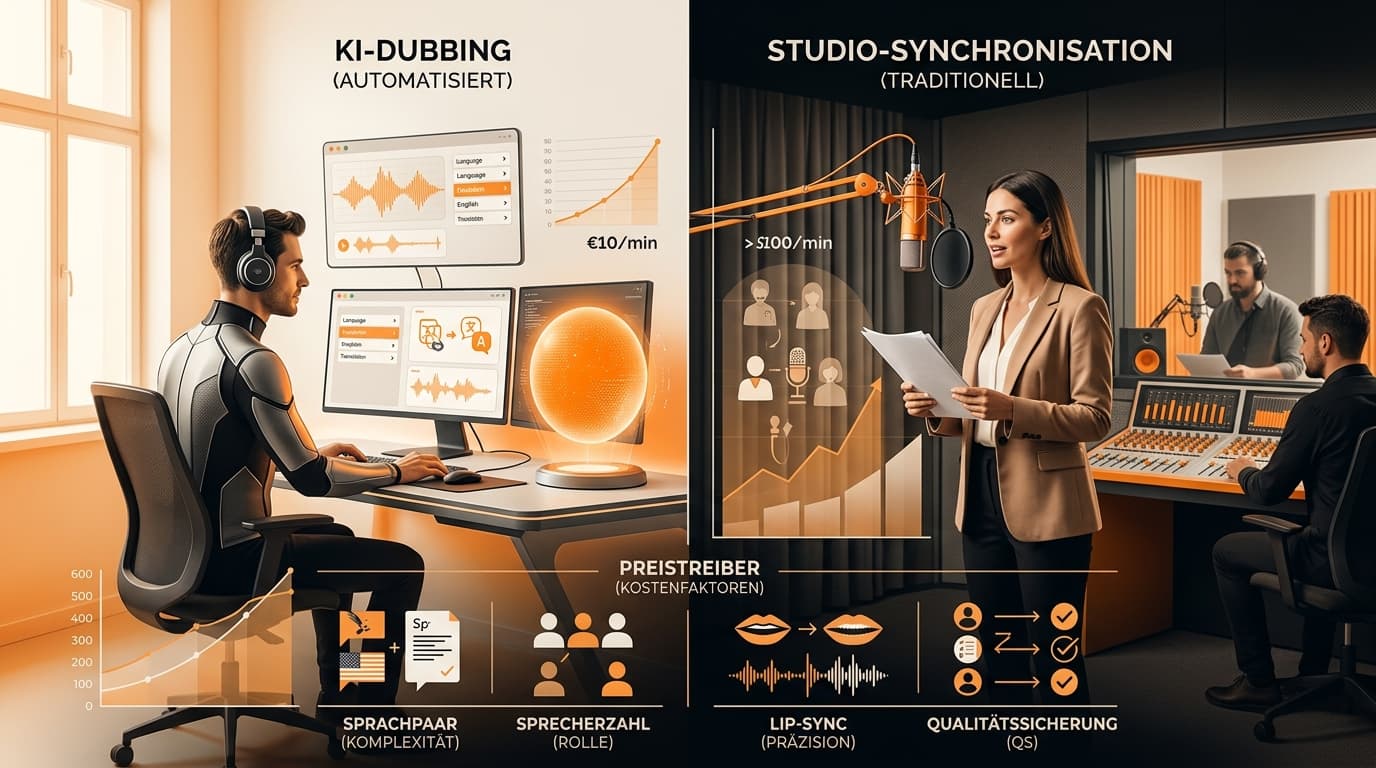
The five main cost drivers behind the per-minute price
Understanding pricing models: minutes, credits and the language multiplier
Hidden costs: QA, post-processing and export restrictions
AI dubbing vs. studio dubbing: when which price pays off
Voice clones and the law: consent as a cost factor
Working out your budget: calculation examples for courses, podcasts and series
Frequently asked questions
Sources
Key takeaways
AI dubbing initially costs about 0.24 to 2.40 US dollars per minute, professional studio dubbing 20 to 40 US dollars, premium productions from 50 US dollars.
The biggest price driver: some providers bill every target language as a separate dubbing minute.
Hidden items such as QA and post-processing account for 10 to 40 percent of the budget.
Voice cloning requires the speaker's documented consent, otherwise there are legal risks.
The market for AI dubbing tools is growing from 1.15 billion USD in 2025 to a projected 2.56 billion USD in 2030.
What AI dubbing costs per minute: the price ranges at a glance
Anyone calculating dubbing budgets needs a figure that can be compared across content, languages and quarters. That figure is the synchronized minute. It is the currency in which AI platforms package their rates, in which studios build their quotes, and in which it ultimately becomes clear whether a localization strategy makes economic sense. The good news: the ranges are known and can be roughly divided into three camps. The bad news: the headline price per minute is rarely the price a team actually pays at the end of the month.
| Segment | Typical range per minute | Characteristics |
|---|---|---|
| AI platform, self-service | 0.24 to 2.40 US dollars | Automated workflow, billing by minutes or credits, quality depends on plan tier and features such as lip-sync |
| AI plus human review | 3 to 12 US dollars | Machine first-pass synchronization, bilingual reviewer checks terminology, register and timing |
| Mid-range studio | 20 to 40 US dollars | Experienced voice actors, standard studio setup, recording, editing and mixing included |
| Premium studio | from 50 US dollars per minute | Premium quality with lip-sync accuracy, professional post-production, script adaptation, voice direction and QA |
Two developments explain why these ranges are reshuffling right now. First, the market for AI dubbing tools is growing, according to market research, from 1.15 billion US dollars in 2025 to a projected 2.56 billion US dollars in 2030, which corresponds to annual growth of 17.3 percent.[4] More providers mean more price points, but also less transparent billing models. Second, multilingual audio tracks on YouTube are now a standard feature rather than a pilot program; according to YouTube's own documentation, channels that use them drew over 25 percent of their watch time from views in a language other than the video's primary language.[5][2] Dubbing has thus moved from nice-to-have to a measurable growth lever, and that is precisely why it is worth not taking the per-minute price as a given but understanding its components.
The five main cost drivers behind the per-minute price
Two providers with seemingly similar rates can end up apart by factors when the same five levers are set differently. Anyone who knows these drivers can compare quotes line by line and knows where the price really comes from.
Language pair: Widely spoken languages with a large pool of voice actors, such as Spanish or Hindi, are significantly cheaper in the studio segment than rare languages like Icelandic or Burmese, for which 50 US dollars per minute and more are charged.[3] For AI platforms, the same effect works through language coverage: the smaller the training material for a language, the more likely it falls into a higher pricing tier.
Number of voice actors: A training video with a single narrator costs significantly less than an animation with twelve roles, because each additional voice creates voice actors, direction and editing time.[3] With AI tools, the number of speakers shows up in speaker detection and assignment effort.
Content type: Animation, gaming and dramatic material demands more expressive performance than educational and training videos and drives the price accordingly.[3]
Lip-sync and expressiveness: Synchronizing mouth movements is considered an expensive extra on several platforms that noticeably increases credit consumption; on Rask AI, enabling lip-sync halves the effective capacity of the plan.[2]
Deadline: Express deadlines incur rush fees in the studio segment because additional studio time and voice actors working in parallel must be booked.[3]
For budget planning this means: the cheapest per-minute price is almost always that of a widely spoken language, a single voice and a content-adjacent format without lip-sync. Any deviation from this is not a negotiation item but a calculable surcharge that should be factored into the calculation in advance.
Understanding pricing models: minutes, credits and the language multiplier
The effective per-minute price only emerges from the billing model, and here the market splits into two camps. Minute-based providers bill every source minute directly, regardless of how many target languages are chosen: a five-minute video dubbed into Spanish and French consumes five minutes of the quota.[1] Credit models, by contrast, share a common pool across several features, such as voice generation, dubbing and subtitles. That is flexible, but it makes the calculation reliable only if it is clear how many credits a synchronized minute actually consumes and which other tasks draw on the same pool.
The biggest stumbling block is the language multiplier. Some providers bill each target language as a separate dubbing run: a ten-minute video in four languages then consumes 40 dubbing minutes instead of ten.[1] For a creator who offers every video in three languages, this triples the effective per-minute price from around $0.55 to $1.65.[1] With large content libraries, this single contract clause determines the entire budget.
Check the base rate: effective entry rates range from around $0.24 per lip-synced minute to about $2.40, depending on whether a provider bills in credits or dubbing minutes.[1]
Factor in the overage rate: once the quota is used up, overage rates apply; with Rask AI, additional minutes cost around $3, so an unexpected ten-minute video means roughly $30 extra.[2]
Run the numbers on a higher tier: the effective per-minute rate drops significantly with the plan, for example from around $2.40 to about $1.50 per minute, and with other providers from $1.00 to $0.55.[2][1]
Hidden costs: QA, post-editing and export restrictions
The headline price typically covers pure machine capacity, not the work that makes a minute publishable. Manual alignment, subtitle corrections and quality assurance by native speakers are recurring line items: practical budget models allocate roughly 10 to 40 percent of the total budget to this depending on content type, and some providers budget 20 to 40 minutes of human review per finished video minute for anything customer-facing.[6][2] Then there is rework: translated speech often runs 15 to 30 percent longer than the original, and if the spoken text overruns the scene, someone has to rewrite and re-render.[2]
Export restrictions also render seemingly cheap plans unusable for professional distribution. Free tiers on some platforms limit export resolution or add watermarks, and with credit-based providers a watermark-free export costs additional credits per minute.[1] That may be fine for social media tests, but not for series, course platforms and client work.
Base rate: what does a synced minute effectively cost, calculated from plan price and included minutes?
Credit conversion: how many credits does a minute consume with and without lip-sync, and which other features draw from the same pool?
Language multiplier: is billing per source minute or per target language?
QA minutes: how much human review is included, and what does an additional review hour cost?
Export formats: are there resolution caps, watermarks or surcharges for distribution-ready masters?
Overage: what rate applies per minute beyond the quota?
AI dubbing vs. studio dubbing: when which price pays off
The question is not which method is better, but which content it suits. AI dubbing is usually entirely sufficient for e-learning, internal training and large content libraries with standard voiceover; here, voice consistency across many modules matters more than acting finesse, and the saving of 80 to 90 percent of production costs versus the studio is the real story.[6] Human voice actors, on the other hand, remain superior for emotional scripts, comedy, lip-sync-critical formats as well as legal and medical content, where nuance, timing and technical precision rest directly on the performance.[3]
| Scenario | Recommended approach | Price logic |
|---|---|---|
| E-learning and internal training | AI workflow with a review pass | AI plus review comes in at $3 to $12 per minute, studio rates at $20 to $40 and more |
| Large video library, multiple languages | AI platform, minute-based billing | No language multiplier, rate drops with volume |
| Emotional scripts, comedy, character formats | Human voice actors in the studio | Expressive performance is the product; savings in the wrong place cost reach |
| Legal and medical content | Studio, or AI with rigorous expert QA | Technical terminology and liability risk demand human sign-off |
For many teams, the cost optimum lies in between: a hybrid workflow in which the AI handles the first pass and human reviewers only fine-tune the critical scenes. Such tiered models, from source review through bilingual spot checks to final sync control, have become the practical standard because they concentrate studio quality where it drives revenue or reputation.[6]
Voice Clones and the Law: Consent as a Cost Factor
Voice cloning is already included in many per-minute prices, but legally it is a separate line item. Cloning a voice requires the speaker's documented consent, because personality and exploitation rights are at stake: someone who once approved a voice for a classic dubbing performance has not automatically consented to every later AI use.[7] The Lehrman and Sage v.[8] Lovo case before a New York federal court shows the direction of travel: the court allowed the speakers' claims under the state's right-of-publicity laws and demanded a substantial justification for the vendor's fair-use defense rather than treating it as a given.
For the budget, this yields three concrete line items. First, licensing and clearance fees for cloned voices, including documented usage rights and terms. Second, GDPR obligations: voice samples count as personal data, data subjects have rights of access, objection and erasure, and consent requires a defined purpose limitation.[9] Third, labeling requirements for synthetic media in regulated markets, which are small but no longer zero.[2] Those who plan for these items upfront pay them as a planning figure; those who skip them pay for them as a risk.
Working the Budget: Worked Examples for Courses, Podcasts and Series
All factors can be combined into a simple formula: source minutes times target languages times the effective per-minute rate, plus a QA share of 10 to 40 percent. Three examples show how differently the result can turn out.
E-learning: A provider localized 250 minutes of training video. In the studio workflow this cost 15,000 US dollars; in the AI workflow with a cloned voice and post-production, 500 to 1,200 US dollars with a production time of five instead of thirty days.[6] Per minute, that works out to a few dollars instead of a double-digit studio rate.[2]
Creator: A ten-minute video in three languages cost 1,500 US dollars in the studio setup; in the AI workflow with a voice clone, 40 to 100 US dollars including editing and subtitles, finished in 24 hours instead of two weeks.[6]
Series or format with lip-sync: Here the language multiplier decides. With billing per target language, the quota load multiplies with every language; with minute-based billing, it does not.[1]
For teams growing beyond their home market, it is worth looking at workflows that do not treat localization as a separate step. An end-to-end content platform like ContentHub Studio embeds transcription, translation and voice cloning directly into the existing publishing workflow, instead of scattering minutes across individual licenses and separate tools; the practical guide to translating video with AI shows the process in detail. How the choice between dubbing and subtitles affects reach is covered in a dedicated comparison of AI dubbing vs. subtitles, and anyone who wants to systematically review the criteria for tool selection will find them in the overview of the best content localization tools. In the end, it is not the lowest anchor price that pays off, but the model that honestly brings source minutes, languages and QA share down to a single number: the cost of the publishable minute.
Frequently asked questions
What does AI dubbing cost per minute?
Pure AI platforms start at roughly 0.24 to 2.40 US dollars per synchronized minute, depending on the plan, lip sync and billing model. Fully managed AI workflows with human quality assurance typically run 1 to 25 US dollars per minute. For comparison: classic studio dubbing costs 20 to 400 US dollars per minute.
Why is studio dubbing so much more expensive than AI dubbing?
The studio price includes voice actor fees, studio rental, dubbing direction, audio editing and QA. Professional studio dubbing costs 20 to 40 US dollars per minute in the mid-range, with high-end productions featuring lip-sync accuracy starting at 50 US dollars. With multiple languages and roles, these items multiply, whereas AI workflows largely eliminate the fixed costs.
Which factors drive the per-minute price the most?
The main drivers are the language pair (rare languages cost significantly more), the number of speaker voices, lip sync as a premium feature, express deadlines and the billing model. Particularly tricky: some providers bill each target language as a separate dubbing minute, which triples the effective per-minute price when working with three languages.
Are there hidden costs on top of the per-minute price?
Yes. Manual alignment, subtitle corrections, quality assurance by native speakers and licensing fees for cloned voices typically add up to 10 to 40 percent of the audio budget. Depending on the plan, export limits such as watermarks or resolution caps also apply, plus overage rates of roughly 0.55 to 3.00 US dollars per minute.
Do I need the speaker's consent for voice cloning?
Yes. Cloning a voice touches personality and exploitation rights and requires the documented consent of the person whose voice is being imitated. Legal analyses show that fair-use defenses for voice-cloning training have so far failed in court because the clones compete directly with the original material.
Is AI dubbing worth it for e-learning and training videos?
Yes, this is where AI dubbing delivers the greatest savings. For a 50-hour training program, total costs in an AI workflow with review come to about 1 to 3 US dollars per minute instead of 20 to 50 US dollars in the studio. However, expert review by native speakers remains critical to avoid errors in content and tone.
How do I calculate my dubbing budget realistically?
Take your source minutes, multiply them by the number of target languages (depending on the provider, each language is billed separately), multiply that by the effective per-minute rate of your plan, and add 10 to 40 percent for QA and post-production. Also compare credit conversions and overage rates before signing a contract.
Sources
[1] perso.ai – https://perso.ai/blog/ai-dubbing-pricing-2026-cost-per-minute-compared
[2] tryscriptai.com – https://tryscriptai.com/blog/how-much-does-ai-dubbing-cost-vs-traditional-dubbing-2026
[3] verbolabs.com – https://www.verbolabs.com/dubbing-prices/
[4] researchandmarkets.com – https://www.researchandmarkets.com/reports/6226959/ai-dubbing-tools-market-report
[5] techcrunch.com – https://techcrunch.com/2025/09/10/youtubes-multi-language-audio-feature-for-dubbing-videos-rolls-out-to-all-creators
[6] dupdub.com – https://www.dupdub.com/blog/localization-budget-roi
[7] srd-rechtsanwaelte.de – https://www.srd-rechtsanwaelte.de/en/blog/ai-dubbing-who-owns-the-voice
[8] skadden.com – https://www.skadden.com/insights/publications/2025/07/new-york-court-tackles-the-legality-of-ai-voice-cloning
[9] iapp.org – https://iapp.org/news/a/voice-actors-and-generative-ai-legal-challenges-and-emerging-protections
Ready to go global?
Translate, re-voice, and package your content for every language, with Dictem.
Open Dictem Studio