Pronunciation in Dubbing: Names and Brands Without Retakes
Jack Clawson
Dictem Editorial
September 16, 2026
11 min
In short
Mispronounced names, brands and technical terms are a common cause of retakes in dubbing. This article shows how a pronunciation glossary, clear research rules and an end-to-end QA workflow prevent errors before the recording starts.
Table of contents
Why pronunciation errors in dubbing become expensive
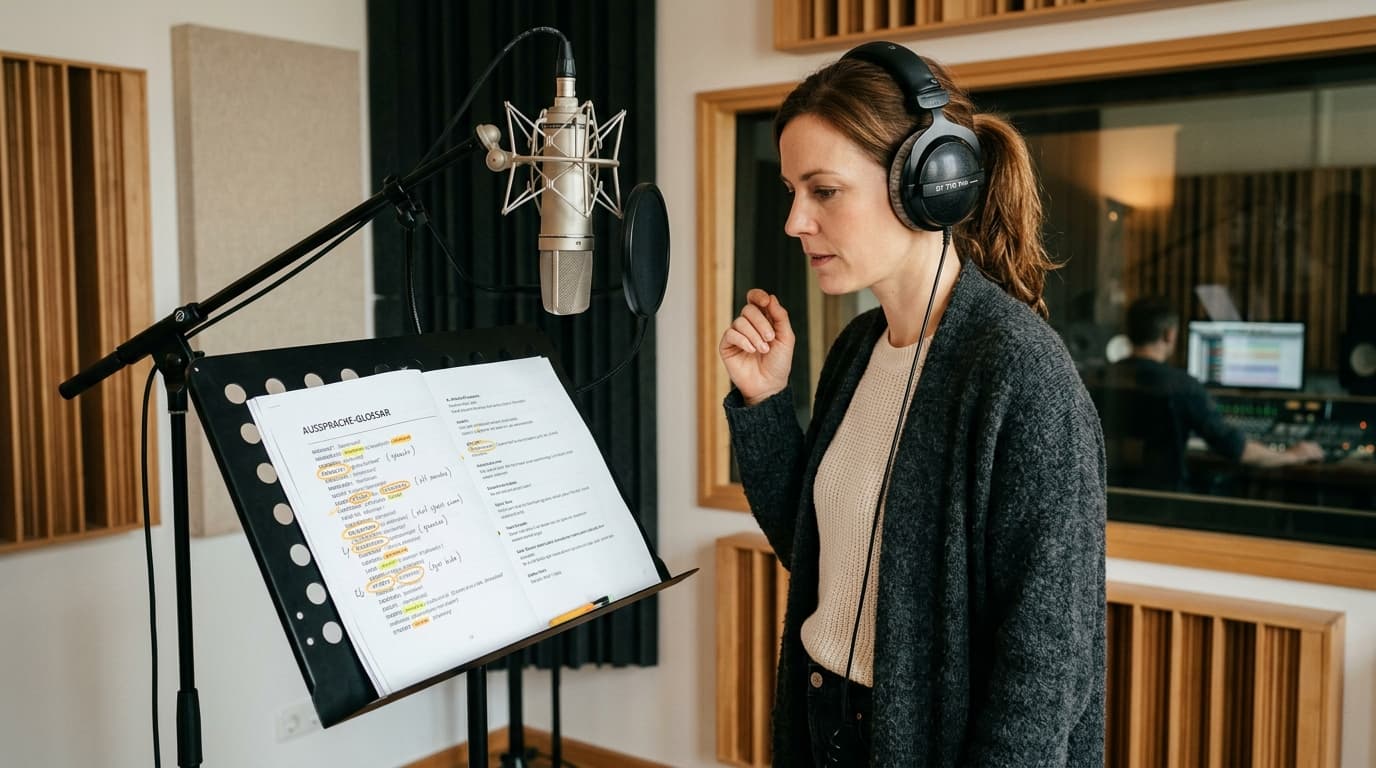
The pronunciation glossary as the central reference
Proper names: diacritics, transliteration and established pronunciation
Brand names and technical terms: research and decisions before the recording
The QA workflow: checkpoints from translation to final sign-off
AI dubbing: pronunciation control in the automated workflow
Checklist: pronunciation sign-off without a retake
Frequently asked questions
Sources
Key takeaways
Netflix expects dubbing teams to research technical terminology in depth so that protagonists retain their expert status.
The spelling and pronunciation of proper names are decided before the dubbing script, not in the booth.
In AI dubbing, the pronunciation glossary is part of the pipeline's input data, not an afterthought.
Glossary entries need a definition, context, forbidden synonyms and status – not just word pairs.
Why pronunciation errors in dubbing become expensive
A mispronounced name in dubbing is not a cosmetic flaw. It forces a retake, ties up studio time and the director's attention, and in the worst case the faulty version reaches the audience: an interview guest whose name the speaker's own community pronounces incorrectly loses credibility instantly. Podcast networks, EdTech teams and studios in particular now produce in many languages in parallel, so every pronunciation error multiplies across all versions.
Proper names of interview guests, authors and characters that have no established pronunciation in the target language
Brand names whose official pronunciation differs significantly from their spelling
Specialist vocabulary from niche domains such as medicine, law or engineering that is not part of the general vocabulary
Acronyms that are resolved or spelled out differently depending on the language
How seriously the industry takes this issue becomes clear when you look at the requirements of major clients: Netflix expects translators and adapters to draw on existing knowledge or conduct thorough research so that the dubbed version conveys the same degree of verbal expertise as the original.[1] An expert who speaks confidently about their field in the original must not suddenly stumble over a glossary in the German or Spanish version.
In automated pipelines the problem becomes even more acute: errors that already occur in transcription, such as a misrecognized proper name, propagate through every downstream step all the way into the finished audio track.[2] Pronunciation QA is therefore not a final quality check – it must start at the beginning of the chain. We compared in more detail which method suits which type of content in our overview of subtitles, voiceover and AI dubbing.
The pronunciation glossary as the central reference
The foundation of any pronunciation QA is a glossary that serves as the single source of truth. In the localization industry this principle is established as a termbase: a central, maintained terminology database instead of scattered Excel spreadsheets in project folders.[3] What matters is that an entry contains far more than a word pair.
| Component | Function in the entry |
|---|---|
| Definition | Explains what the term denotes and what it does not |
| Context example | Shows the term in an active example sentence |
| Part of speech | States noun, verb or adjective, important for languages with complex grammar |
| Forbidden synonyms | Explicitly specifies which alternative formulations must not be used |
| Status | Marks the entry as Draft, Approved or Deprecated |
| Phonetic transcription | IPA transcription or respelling as the binding pronunciation guide |
| Reference audio | Short clip with the term spoken correctly as an audio reference |
The last two rows are what distinguish a pronunciation glossary from a classic terminology list. A phonetic transcription alone only helps the speaker in the booth to a limited extent when the pronunciation is unfamiliar; a reference clip of two to three seconds in which the term is spoken clearly once replaces any discussion. Modern speech synthesis systems follow the same path and accept reference audio that serves as a pronunciation template during synthesis.[4]
The glossary is best maintained by a small, fixed group: translators provide the linguistic form, subject-matter experts and product teams validate content and spelling, and a terminology owner decides on status changes. This cross-functional setup prevents technically correct but off-brand decisions from being passed on into dozens of target languages.[3]
Proper names: diacritics, transliteration and established pronunciation
For personal names, place names and fictional names, a gut decision in the recording studio is not enough. Three rules have become established as the standard and can be adopted directly into the glossary.
Diacritics are preserved as long as official sources use them: names such as Mónica Naranjo or Pedro Almodóvar keep their accents, while names that are written without an accent for cultural reasons do not get one added afterwards[5]
Unfamiliar characters are transliterated when they would be confusing or hard to pronounce in the target writing system: the Icelandic name Þór becomes Thór, the Torstraße becomes Torstrasse[5]
For established brands and franchises, the existing reference translations from books or games that the client names as binding sources apply, and established voice actors are reused so that a character sounds the same over the years[1]
For the audio track this means: the decision about spelling and pronunciation is made before the dubbing script, not during the recording. The German Netflix style guide reinforces this point by stipulating that proper names are generally not translated unless an approved translation exists.[6] Anyone who maps these requirements as glossary fields has a reliable reference for every subsequent project instead of a memory gap.
Brand names and technical terms: research and decisions before the recording
Brand names and technical terminology have one thing in common: both carry expert status, and both often only become an issue in the studio when the recording is already underway. Both can be resolved with a short decision sequence before the microphone.
Research the official pronunciation: corporate communications, investor relations videos, interviews with founders and commercials reliably show how a company pronounces its own name. The result is recorded in the glossary with a reference link.
Weigh original-language vs. target-language pronunciation: if an established pronunciation or spelling has already taken hold in the target country, it is used; otherwise the original pronunciation is retained.[6] Netflix explicitly permits using the name known in the target country for brands and trademarks
Validate specialist terminology with subject-matter experts: terms from medicine, law, finance or technology are confirmed by someone who speaks the domain. If the client provides no reference sources, Netflix requires translators to proactively do their own research so that the characters' expertise is preserved[1]
At the end of this sequence, the director is not left with a discussion outcome in their head, but with a glossary entry with status Approved, phonetic transcription and reference audio. That way, the next production and the next target language start from the same level of knowledge.
The QA workflow: checkpoints from translation to final acceptance
A glossary only works if it is built into the production process. A three-stage checking process has proven its worth, each stage producing a clear result before the project moves on.
| Stage | Checkpoint | Result |
|---|---|---|
| Dubbing script review | Cross-checking all names, brands and technical terms against the glossary before voice talent is booked | Approved script with no open pronunciation questions |
| Recording under direction | The dubbing director checks pronunciation against reference audio without crushing the performance: articulation does not always have to be perfect – what matters is intelligibility and a credible, natural performance | Recorded material with confirmed pronunciation |
| Full-runtime check | Complete runtime check of the finished version before release, measured against a metric such as Errors Per Thousand (EPT) for terminology errors | Documented release with no known pronunciation errors |
The third stage is the most frequently underestimated. A localization lead at a major TV broadcaster put it plainly to Slator: quality controls remain necessary, and not as spot checks but as a full quality review across the entire runtime.[2] A spot check at the beginning of the material will no longer catch the name that is mispronounced in minute 34. The dubbing script review before booking is the most economical lever here: an error corrected at this stage costs a text change, not a studio hour.
AI dubbing: pronunciation control in the automated workflow
With AI-assisted dubbing, the chain of speech-to-text, machine translation and voice synthesis runs without a booth or a director. The error propagation described above then runs unchecked, because no one is listening along and correcting: whatever goes wrong in the transcription only lands on the desk in the finished audio track, where it is much harder to find and more expensive to fix.[2] The pronunciation glossary therefore belongs to the pipeline's input data, not to the afterthoughts.
The economic incentive is huge: buyers interviewed for the Slator AI Dubbing Report 2025 reported rates up to 80% lower than with traditional dubbing.[2] It is precisely this saving that makes it possible to localize content that previously was not dubbed at all for cost reasons – and it does not make clean pronunciation control redundant but more important, because volume is increasing.
Pronunciation lexicons and pronunciation editing steer names and acronyms: a reference recording is stored for each term, which the language model uses as a template during synthesis[4]
The mechanism is most effective for rare words: brand names, medical and technical terms and foreign-language names benefit the most, while common words barely steer the model[4]
The reference clips should be recorded in a voice of similar timbre and in the target accent, otherwise the synthesis risks an unwanted accent shift[4]
For externally visible content, a full human review remains the standard: it catches not only pronunciation errors but also unnatural pauses and voice inconsistencies that native speakers notice immediately.[2] We have summarized how AI voiceover and AI dubbing fit into the language workflow in our overview of AI voiceover in multiple languages.
Checklist: Pronunciation Sign-Off Without Retakes
At the end of every project there should be a short, binding checklist that is anchored in the workflow and worked through before sign-off.
Glossary: every name, brand and technical term in the project at Approved status
Reference audio: a clip on file for every critical pronunciation
Diacritics and transliteration: checked against the official sources
Brand pronunciation: official or locally established pronunciation documented
Sign-off: results of the runtime check documented, open issues named
Feedback loop: newly surfaced terms fed back into the glossary
The feedback loop is what matters: new names and terms that surfaced during the project are fed back into the glossary after acceptance. Terminology work follows a cycle of four phases – development, adoption, quality control and ongoing maintenance – and thrives on reviewers and linguists being able to simply report the errors they find.[3] That way, every project becomes a better starting point for the next.
Where the glossary and sign-off steps live determines whether the checklist is actually used or disappears into scattered files. Stored centrally, for example in ContentHub Studio, the reference is reachable for every team member in every project, instead of withering away in local spreadsheets. For teams that treat localization as an integral part of production rather than bolting it on afterwards, it is worth taking a look at our Playbook on the localization-first way of working. Dictem, based in Hamburg, supports studios, podcast networks and EdTech teams in producing multilingual audio and video content with consistent pronunciation – from the glossary all the way to final sign-off.
Frequently asked questions
What belongs in a pronunciation glossary for dubbing projects?
One entry per name, brand and technical term, with a definition, context example, part of speech, forbidden synonyms and status (Draft, Approved, Deprecated), plus phonetic transcription or respelling and ideally reference audio. Maintained centrally so that translators, directors and voice actors all draw on the same source.
How are proper names with special characters handled in the dubbed version?
Two rules apply: diacritics are retained as long as official sources use them, and unfamiliar characters are transliterated when they would cause confusion in the target writing system. Both are covered in the Netflix Timed Text Style Guides and can be carried over to any project as a glossary field.
Should a brand name be pronounced in the original or localized?
First research the official brand pronunciation, for example via corporate communications or advertising spots. If an established pronunciation exists in the target country, use that; otherwise use the original pronunciation. The decision is recorded in the glossary so that all episodes sound consistent.
How do you ensure pronunciation quality in AI dubbing?
AI dubbing chains together speech recognition, machine translation and voice synthesis, with transcription being the most critical stage. Pronunciation lexicons and pronunciation editing steer names and acronyms in a targeted way, while the documented full check before sign-off remains the endpoint of the QA workflow.
At what point is dubbing recommended over subtitles?
In its dubbing guidelines for nonfiction and unscripted content, Netflix recommends dubbing once foreign-language dialogue makes up roughly 40% or more of the runtime, because too many burned-in subtitles (forced narratives) disrupt the viewing experience.
Who decides how technical terms are pronounced?
The basis is subject-matter research plus alignment with experts or the rights holder. Netflix expects dubbing teams to independently and thoroughly research domain-specific vocabulary when no reference sources are provided, so that voice actors sound just as competent in the target market as in the original.
What does a pronunciation retake cost?
Concretely, the costs depend on studio time, voice actor bookings and the schedule. An error caught during the dubbing script review costs a text correction; the same error after recording means a new studio session including mixing and acceptance.
Sources
[1] partnerhelp.netflixstudios.com – https://partnerhelp.netflixstudios.com/hc/en-us/articles/11220839130771-Dubbing-Creative-Guidelines-Films-Series-English
[2] acolad.com – https://www.acolad.com/en/services/translation/multimedia/how-does-ai-dubbing-work
[3] translated.com – https://translated.com/resources/terminology-management-a-strategic-guide-to-global-consistency
[4] docs.resemble.ai – https://docs.resemble.ai/platform-management/custom-pronunciations
[5] partnerhelp.netflixstudios.com – https://partnerhelp.netflixstudios.com/hc/en-us/articles/217350977-English-USA-Timed-Text-Style-Guide
[6] partnerhelp.netflixstudios.com – https://partnerhelp.netflixstudios.com/hc/en-us/articles/217351587-German-Timed-Text-Style-Guide
Ready to go global?
Translate, re-voice, and package your content for every language, with Dictem.
Open Dictem Studio