RSS Strategy for Localized Podcasts: One Feed per Language?
Jack Clawson
Dictem Editorial
September 16, 2026
4 min
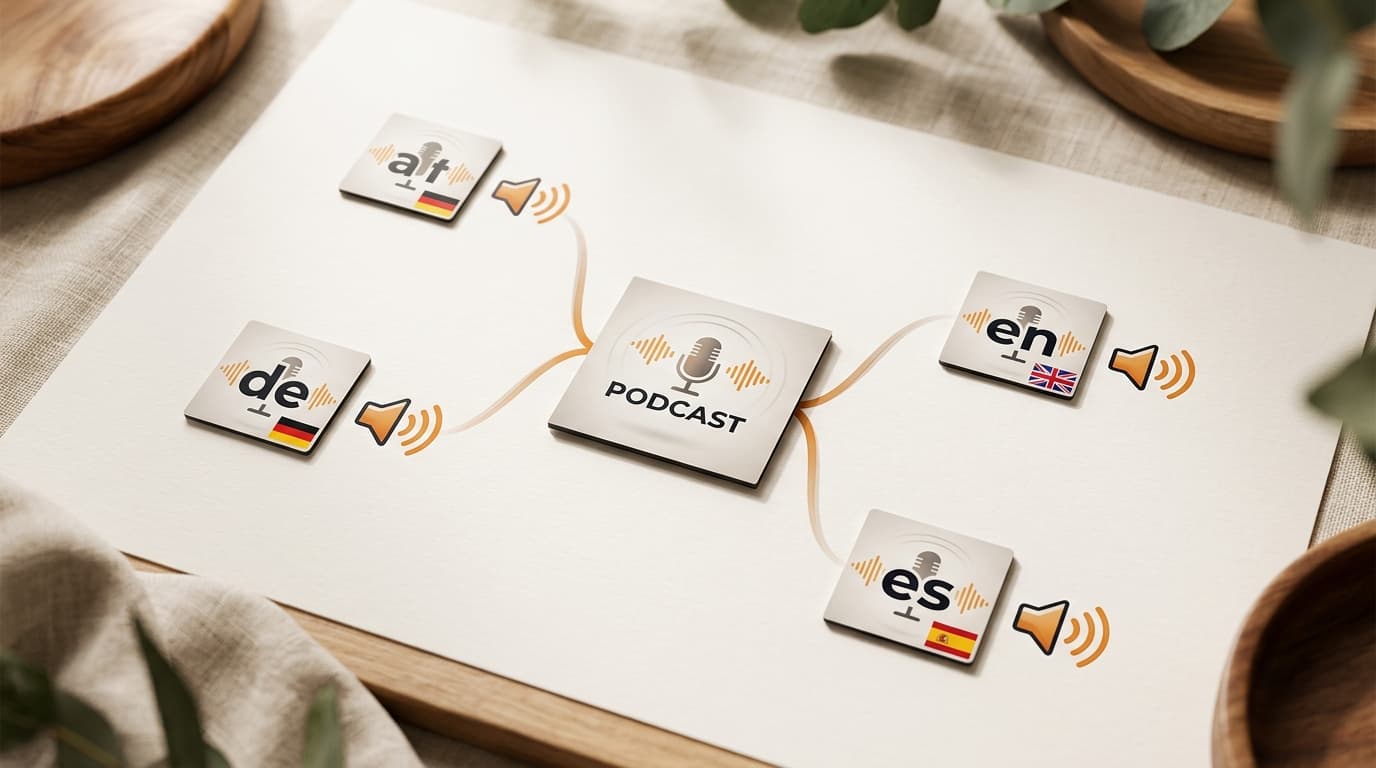
In short
This article compares the "one feed per language" model with the shared feed, places the technical requirements of RSS and Apple Podcasts in context, and shows how an existing feed can be cleanly migrated to multiple language versions.
Table of contents
Why the feed question must be decided before translation
Frequently asked questions
Sources
Key takeaways
The RSS language tag applies to the entire feed: one feed represents exactly one language in directories.
For translated content, one feed per language is the standard, with its own ranking, its own analytics and its own cover art.
A shared feed only suits shows that are naturally bilingual.
Technical obligations remain: a valid ISO-639 code, stable unique GUIDs per episode, and itunes:new-feed-url for migrations.
Why the feed question must be decided before translation
Anyone who wants to take a podcast into other languages thinks about translation first: which tool, which speaker, what quality? But the real decision is made elsewhere, and before the first translated minute: in the RSS feed. The feed is your podcast's directory interface. It determines which language catalogs your show appears in, how it is ranked, which analytics data arrives per version, and how listeners subscribe to it. And this architecture can only be corrected later at a loss: subscribers, chart history and reviews are attached to the feed, not to the audio file.
The incentive to go multilingual in the first place is strong. The global podcast market keeps growing, and platforms are investing in localization themselves: in September 2023, Spotify launched a pilot for AI-powered voice translation, in which selected episodes appeared in the original speaker's voice in Spanish, French and German.[1] The demand for foreign-language versions is there. The only question is which feed structure it arrives in.
In 2025, around 584.1 million people worldwide listen to podcasts monthly; about 652 million are forecast for 2027.[2]
With around 22.1 million monthly listeners, Germany trails markets such as China (117.1 million), Brazil (51.8 million) and Mexico (27.5 million): growth is increasingly happening outside the English-speaking world.[3]
The feed decision permanently determines ranking, analytics and subscriber management, and can only be corrected afterwards at a loss.
The next sections therefore look under the hood of the RSS standard: what exactly the language tag does, where a shared feed reaches its limits, and how a migration works technically.
Frequently asked questions
Should I create a separate RSS feed for each language?
For translated or re-recorded content, yes. Since the language tag applies at channel level and a feed can only represent one language, one feed per language delivers clean metadata, its own ranking in the directories, and separate analytics per language version.
Can a single RSS feed cover multiple languages?
Technically yes, but with limitations. The language tag only accepts one value, and directories like Apple Podcasts filter by it. A mixed feed is disadvantaged for the second language in search and recommendations, which is why the podcast community recommends two feeds for clean localization.
Which language code must the RSS feed contain for Apple Podcasts?
Apple Podcasts only accepts values from the ISO-639 list, such as de or en-us. Invalid language codes cause the feed to fail validation; the language tag is mandatory at channel level.
What happens if translated episodes share the same GUID as the original?
This creates duplicates. Every episode must have a globally unique GUID that never changes, otherwise Apple Podcasts shows episodes twice, analytics become inaccurate, and charts as well as the listing suffer.
How do I migrate an existing feed when switching to one feed per language?
Set the itunes:new-feed-url tag in the new feed and keep the old feed running in parallel until subscribers have migrated. Apple explicitly recommends this method for URL changes so that no listeners are lost.
Does each language version need its own cover art and metadata?
Yes. Title, description, and cover art should be fully in the target language, because directories display exactly these fields in search and in the language catalogs. A cover with a foreign-language show title or subtitle signals to listeners that the episode is not in their language and costs clicks; in addition, localized titles and descriptions are the text basis that directory search draws on.
Is podcast localization worth it if feed effort increases?
As a rule, yes. Listener numbers are growing especially outside English-speaking markets (see the figures earlier in the article), and a second feed is a one-time setup effort while permanently delivering its own ranking and clear analytics.
Sources
[1] reuters.com – https://www.reuters.com/technology/spotify-tests-voice-translation-feature-podcasts-2023-09-25
[2] teleprompter.com – https://www.teleprompter.com/blog/podcast-statistics
[3] meetanshi.com – https://meetanshi.com/blog/podcast-statistics/
Ready to go global?
Translate, re-voice, and package your content for every language, with Dictem.
Open Dictem Studio