Singable Translation with AI: Checking Rhyme, Meter and Prosody
Jack Clawson
Dictem Editorial
September 16, 2026
12 min
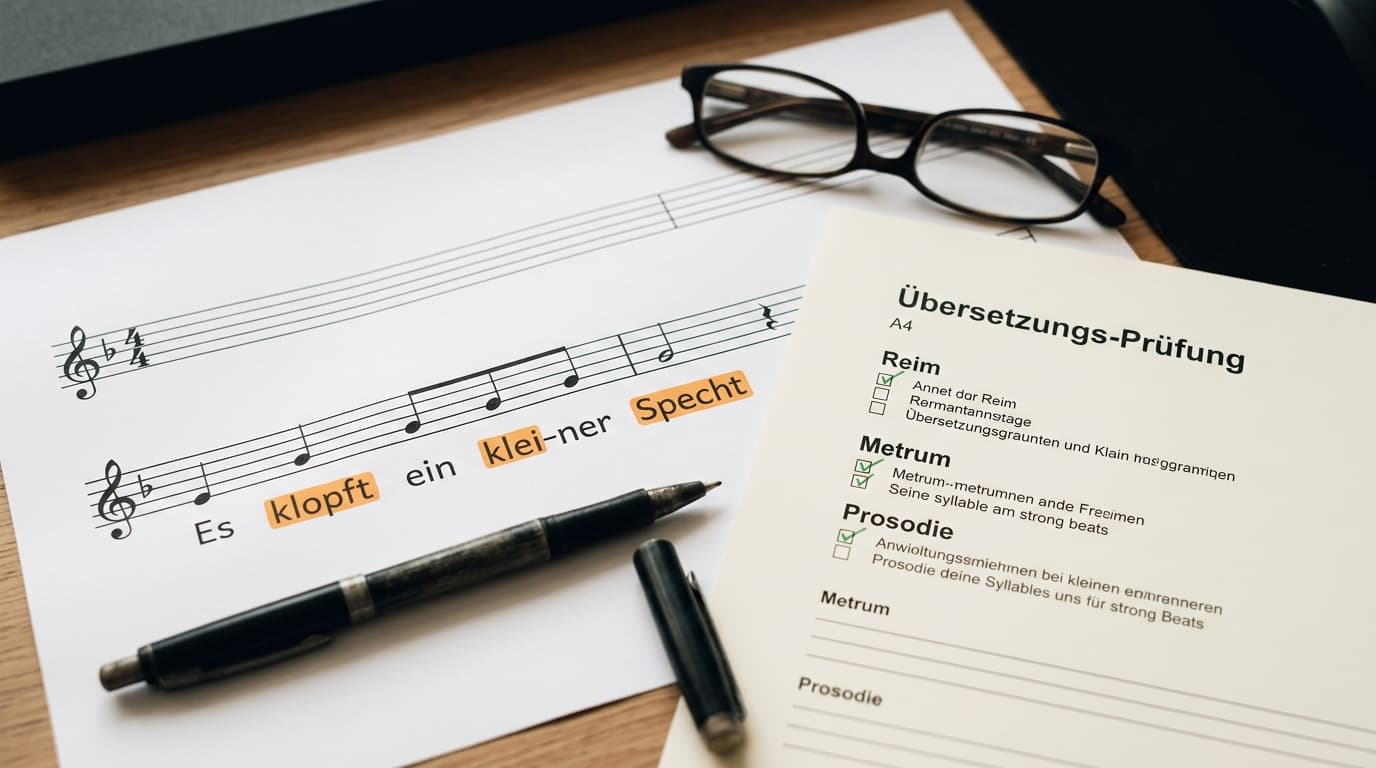
In short
Singable translation demands more than correct English: rhyme, meter and prosody must fit the melody. This article applies the Pentathlon Principle of translatology to the QA check of AI lyric rewrites and ends with a practical acceptance checklist.
Table of contents
What distinguishes singable translation from ordinary translation
The Pentathlon Principle as a QA grid for lyric rewrites
Checking rhyme: preserving the rhyme scheme without forcing it
Meter and syllable count: line length and word boundaries within the beat
Prosody: stressed syllables on strong beats
AI workflows: prompting, reward models and evaluation
QA checklist for everyday production
Frequently asked questions
Sources
Key takeaways
The Pentathlon Principle by Peter Low (2003) balances five criteria: singability, sense, naturalness, rhyme and rhythm
AI systems with length and rhyme control now hit syllable counts and rhyme schemes almost consistently (Ou et al., ACL 2023)
Even human lyric translations achieve nearly zero BLEU-2, so classic MT metrics are useless as a QA measure
Automatic metrics predict singability only partially; the CCVO metric over consonant clusters and vowel openness performs best
Prosody is the hardest QA point and the reason why a sing test always comes last
What distinguishes singable translation from ordinary translation
Anyone who runs a song lyric through a general-purpose machine translation usually gets a factually correct but unsingable text. The reason is structural: machine translation optimises for semantic fidelity while ignoring exactly the properties that make a text performable. Note values, stress patterns and rests of the melody are left out, and the text falls apart at the singer's very first trial run. Ou and colleagues from the National University of Singapore show in their ACL study Songs Across Borders where generic neural translation fails concretely: overcrowded syllables force singers to break musical notes into pieces, multisyllabic words land over musical rests, and line endings miss the rhyme scheme of the original.[1]
Singable translation is therefore not a translation goal but a performance goal: the text must not only mean the same thing but be singable to the same melody, sound like a text composed in the target language, and maintain the poetic level of the original. In translatology, a framework has been established for this since Peter Low's Pentathlon Principle of 2003 that is still accepted by song translators today: quality emerges from the balance of five aspects, much like a pentathlete who must score in every discipline.[2] How this principle can be systematically implemented in the translation process is covered in our guide to singable text translation; this article focuses on quality assurance.
For production and localization teams, this raises a practical question: if AI systems deliver lyric rewrites in dozens of languages, how do you measure before release whether the result is truly singable? The Pentathlon Principle can be used as a QA framework for exactly this, and current research now even provides measurable criteria for each of the five disciplines.
Syllable overflow: the translation does not fit the notes, and singers have to break notes apart.
Wrong word boundaries: multisyllabic words fall across musical rests or emphasized notes.
Missing end rhymes: the rhyme structure of the original is lost, and the lyrics feel less poetic.
Unnatural phrasing: vocabulary and word order sound translated, not composed.
The Pentathlon Principle as a QA Framework for Lyric Rewrites
Low's five aspects – singability, sense, naturalness, rhyme and rhythm – can not only be discussed qualitatively but measured individually. Štěpánková and Rosa from Charles University computationally interpreted the Pentathlon Principle in 2025 and broke it down into five measurable metrics, whose target values they calibrated against those of human translators.[2] For a QA check, this means: every criterion has a concrete measurable quantity instead of a vague overall assessment.
| Criterion | What is checked | Metric |
|---|---|---|
| Singability | Consonant clusters and vowel opening compared to the original | CCVO distance (Levenshtein distance over phonetic transcription patterns) |
| Sense | Faithfulness of meaning to the source text | Cosine similarity of Sentence-BERT embeddings |
| Naturalness | Idiomatic word order and register in the target text | Perplexity of a pretrained language model |
| Rhyme | Agreement of the rhyme scheme with the original | Jaccard index over the rhyme edges of the stanza |
| Rhythm | Syllable count per line against the melody | Syllable distance rather than strict syllable accuracy |
This is precisely why classical translation metrics are unsuitable for this check: the study replaces them with five of its own measures, because translators under melodic constraints can rarely choose the most direct wording, so literal agreement with the source text says nothing about the quality of the adaptation.[2] A rewrite optimized for a high BLEU score therefore optimizes past the performance goal.
The consequence for the QA check is: it is assessed in a balanced way across all five aspects, not via a single score. A rewrite with a perfect syllable count but clunky prosody fails just as much as a sense-faithful text with a forced rhyme. The pentathlon image is meant literally here: what counts is the overall performance, not a record in a single discipline.
Checking Rhyme: Preserving the Rhyme Scheme Without Forcing It
Rhyme is the criterion where AI rewrites fail or shine most visibly. What matters first is Low's basic idea, which the computational reading of the Pentathlon Principle adopts: rhyme is one of five equally weighted aspects, not an obligatory exercise. Fewer or differently placed rhymes are often better than a forced rhyme scheme that costs sense and naturalness.[2] A clunky rhyme that sacrifices both is not a mark of quality but a loss of quality with a rhyming sound.
For measuring rhyme, the same paper proposes the Jaccard index: the original and new rhyme schemes are mapped as graphs over the line indices, and the index calculates the share of shared rhyme edges among all rhyme edges.[2] The advantage over pure recall metrics: a rewrite is not penalized if it artistically introduces a new rhyme, but neither is it rewarded if every line rhymes with every other.
On the generation side, Ou and colleagues show how AI systems can hit rhyme schemes precisely: through backward decoding, in which the model first chooses the last word and translates from back to front, the system imitates the old trick of human translators of building rhyming sentences from the last word onward. Building on this, a rhyme ranking selects the rhyme variant that sounds most natural. Their English–Chinese system thereby achieves 99.00 percent rhyme accuracy.[1]
For the QA check, one question remains that no metric can reliably answer: does the line rhyme naturally, or does the rhyme sound contrived? A rhyme can be scheme-correct and still sound strained to the ear. Anyone who only looks at the score here releases lyrics that stand out at the very first recording session.
Meter and Syllable Count: Line Length and Word Boundaries in Time
Rhythm is the hardest constraint in lyric rewriting, because the number of syllables per line is fixed by the melody. What is interesting is how research measures this constraint: not as strict syllable exactness, but as syllable distance. Štěpánková and Rosa argue that an eleven-syllable line that is one syllable too short is tolerable, while a line that has to fill ten syllables in the rewrite from three syllables in the original is catastrophic.[2] The relative distance to the original length, not a binary hit rate, therefore captures what singers actually feel.
The second rhythmic checkpoint is word boundaries. A multisyllabic word must not fall across a musical rest and must not land with its second or later syllable on an emphasized note, otherwise unnatural pronunciation results, as documented by Ou and colleagues as a typical failure of generic MT. Their system steers necessary word boundaries via prompts and achieves 99.85 percent length accuracy as well as a 95.52 percent word-boundary hit rate.[1]
REFFLY (Revision Framework for Lyrics) from UCLA takes a different path: instead of generating lyrics from scratch, the model revises an existing prose draft so that it fits the melody. This is precisely what makes the approach practical for song translation, because an unsingable raw text is the normal case in the workflow, and the authors themselves name song translation as a use case.[3]
Mark multisyllabic words that could fall across a musical rest or land on an emphasized note.
When rewriting drafts: plan syllables before polishing the wording.
Prosody: Stressed syllables on strong beats
Singability in the narrower sense is prosody: the mapping of stressed syllables to strong beats and long vowels to long notes. The XAI-Lyricist system from the National University of Singapore uses precisely this musical prosody to steer language models during text generation, and makes the mapping visible as an explanation, for example which syllable falls on which beat.[4]
Particularly instructive for QA teams is the accompanying study: in a controlled investigation with 14 trained singers, the system was evaluated not only with metrics such as perplexity and Prosody-BLEU, but also on how much time and how many attempts participants needed until a line could be sung cleanly.[4] The translation for everyday production: when the rewriter reports not only text but also the stress logic, acceptance testing becomes faster and better grounded.
Reffly implements the same idea on the generation side: nouns, verbs and adjectives as prominent words are aligned with prominent notes, that is, stressed beat positions, syncopations, or notes with a large leap. In the experiments, the system outperformed baselines including GPT-4 by 25 percent on musicality.[5]
The typical QA pitfalls remain audible: consonant clusters and closed vowels on fast note sequences make lines physically strenuous to sing, even when syllable count and rhyme are correct. Low's Pentathlon principle captures exactly this under singability: large consonant clusters and tight syllables are uncomfortable when the melody is not adapted to them.[6]
AI workflows: prompting, reward models and evaluation
How do current AI systems actually generate singable rewrites, and how are they evaluated? For LLM-based workflows, Liu, Sakai and Watanabe (EACL 2026) provide the most systematic answer: they compare seven prompting strategies of increasing complexity, from simple zero-shot translation to multi-stage dialogues with verification steps.[7]
Verification-guided prompts: the model explicitly checks syllable count, rhyme patterns and sense-bearing words instead of merely being told the constraints.
Multi-stage prompting: a second round refines the first draft, targeted for example at syllable count.
Finding: multi-stage strategies improve rhythm and phonological naturalness, moderately complex strategies increase perceived singability the most, and more complex ones deliver more stable results.
Meta-finding: among all automatic metrics, the CCVO metric, i.e.[7] the distance over consonant clusters and vowel opening, correlates most strongly with human perception of singability.
For musical lyrics, this is not enough, because musicals demand higher translation quality than pop songs: the lyrics carry the plot, and the translation must preserve that narrative function. Ye and colleagues (EMNLP Findings 2024) train reward models for the automatic evaluation of translation quality and combine them with a two-stage training process in which the model first learns the singability constraints and then refines translation quality.[8]
The QA-relevant point of both papers is the same: automatic evaluation is possible, but multidimensional. Anyone approving rewrites should check at least syllable count, rhyme and semantic similarity separately, and treat the automatic scores as a filter, not as an approval.
QA checklist for everyday production
For production and localization teams revising jingles, musical and advertising song lyrics in multiple languages, the research yields a concise acceptance checklist. It checks line by line and deliberately follows the order from hard to soft: first the text must fit the melody mechanically, then comes the sound, then the meaning.
Check the syllable count against the notation, rating deviations relative to line length.
Match word boundaries against musical rests and emphasized notes.
Match the end rhyme against the rhyme scheme of the original and question whether every rhyme sits naturally.
Check stress against the metrical weight, i.e. the prosody mapping from the previous section.
Match the meaning against the source text, using Sentence-BERT similarity as a pre-filter and a human eye for the narrative function.
Test naturalness by reading aloud: word order, register and idiom must sound like an original lyric.
Sing test with a real recording as the final approval stage.
The sing test remains the final approval stage because automatic metrics only partially predict singability.[7] The XAI-Lyricist study also shows that professionals detect unsingable lines more reliably when the prosody logic is visibly laid out before them.[4] If you then produce the approved lyrics in multiple languages, you will find the technical side in our guide on AI voice-over.
Frequently asked questions
What is a singable translation?
A singable translation is intended for performance in the target language, not just for reading. It must fit the melody of the original – observing syllable count, stresses, rests and rhyme scheme – while preserving meaning and naturalness. Peter Low formulated the Pentathlon Principle for this in 2003, with five criteria to be balanced.
Which five criteria does the Pentathlon Principle check?
Singability (comfort when singing to the melody), sense (fidelity of meaning), naturalness (idiomatic target language), rhyme (rhyme scheme) and rhythm (syllable count and stress patterns). As in a pentathlon, all five aspects must be balanced – a single perfect score does not save the translation.
Can AI already translate song lyrics singably?
Yes, with limitations. Prompt-driven systems such as that of Ou et al. achieved 99.85 percent length accuracy and 99.00 percent rhyme accuracy on English-Chinese. Studies with large language models also show that verification-guided and multi-stage prompts significantly improve rhythm and phonological naturalness.
How do I check the rhyme and meter of an AI rewrite?
Count the syllables per line and match them against the notes of the melody; then check whether the rhyme scheme of the original is preserved, for example using the Jaccard index over rhyming line pairs. Make sure that multisyllabic words do not fall across musical rests, and read the lines aloud to spot forced rhymes.
What does prosody mean in song lyrics?
Musical prosody refers to the mapping of stressed syllables to strong beats and of long vowels to long notes. Without this mapping, the text sounds bumpy or is barely singable. Studies such as XAI-Lyricist show that prosody visualizations help singers judge the singability of AI lyrics faster.
Is automatic evaluation enough, or is a human sing test needed?
Automatic metrics only partially capture singability: the CCVO metric correlates most strongly with human perception, but studies unanimously emphasize that human evaluation remains decisive. A sing test with a real recording is the final quality filter before an AI rewrite is approved.
Sources
[1] aclanthology.org – https://aclanthology.org/2023.acl-long.27/
[2] aclanthology.org – https://aclanthology.org/2025.nlp4dh-1.11/
[3] aclanthology.org – https://aclanthology.org/2025.naacl-long.564/
[4] ijcai.org – https://www.ijcai.org/proceedings/2024/872
[5] aclanthology.org – https://aclanthology.org/2025.naacl-long.564.pdf
[6] aclanthology.org – https://aclanthology.org/2025.nlp4dh-1.11.pdf
[7] aclanthology.org – https://aclanthology.org/2026.eacl-srw.42.pdf
[8] aclanthology.org – https://aclanthology.org/2024.findings-emnlp.315/
Ready to go global?
Translate, re-voice, and package your content for every language, with Dictem.
Open Dictem Studio