Speaker Diarization: Synchronizing Multilingual Podcasts
Jack Clawson
Dictem Editorial
September 16, 2026
13 min
In short
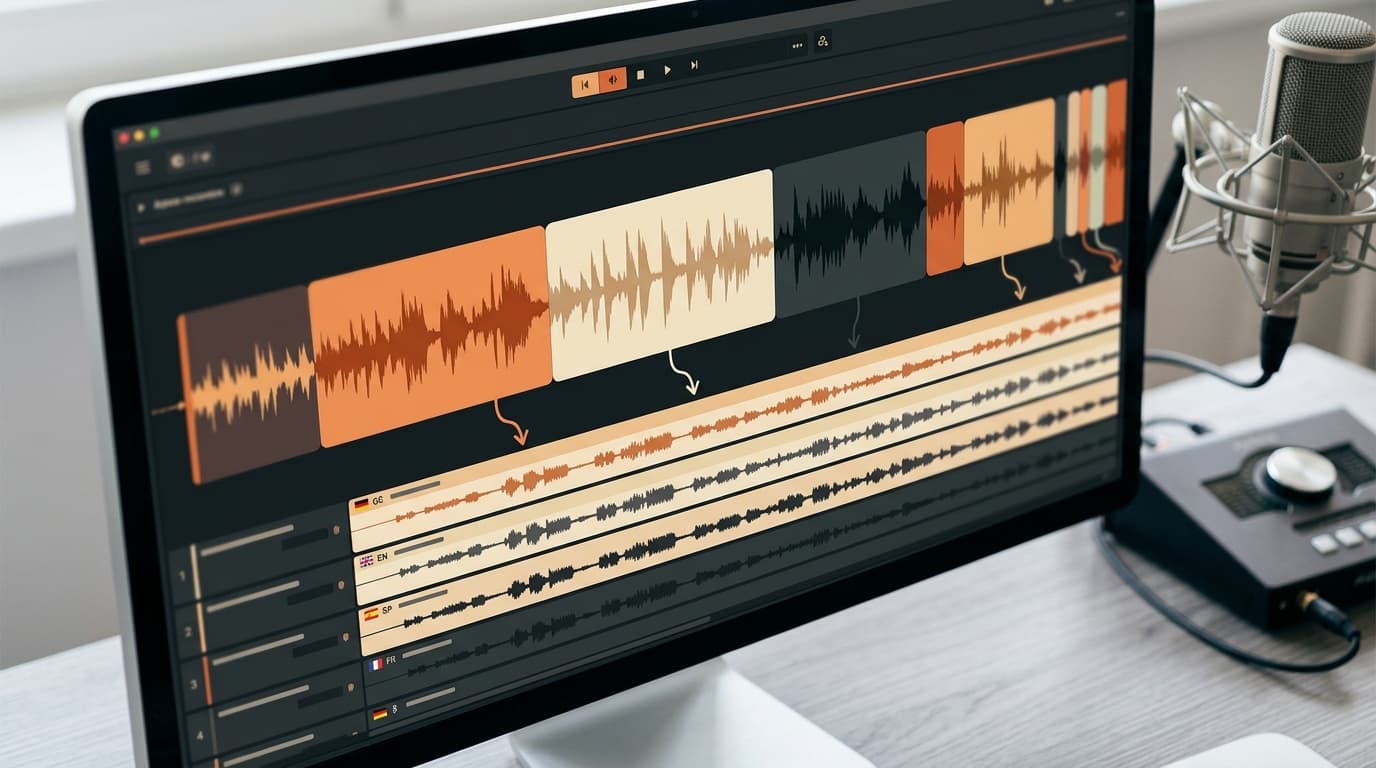
Speaker diarization answers the question of who spoke when, making it the foundation of any AI dubbing of podcasts with multiple voices. This article explains the workflow from speaker segment to finished language version, the typical sources of error, and the practical rules for clean results.
Table of contents
What speaker diarization does: Who spoke when
Why multilingual podcast dubbing is gaining importance
From speaker segment to synchronized version: the workflow
Sources of error in multi-host formats and interviews
Recording practice: How teams improve diarization and dubbing
Voice rights and transparency: Consent for AI voices
Implementing multilingual podcast workflows with ContentHub Studio
Frequently asked questions
Sources
Key takeaways
Speaker diarization breaks multi-person audio into assigned speaker segments, providing the foundation for translation and re-voicing per voice.
Strong systems achieve a diarization error rate in the low single-digit percentage range on clean studio audio.
Accuracy breaks down from five speakers onward: NVIDIA's Sortformer sits at 13.24 percent DER with up to four speakers and at 42.56 percent from five speakers onward.
Since September 2023, Spotify has been translating podcasts into Spanish, French and German in the voice of the original hosts.
The same sentence turns out significantly longer or shorter depending on the language, which is why synchronization is always also a timing problem.
What speaker diarization does: Who spoke when
In a multi-person recording, speaker diarization answers a seemingly simple question: Who spoke when? Technically, it partitions the audio stream into speaker-homogeneous segments, each with a start time, an end time, and a speaker index, usually serialized as an RTTM segment list. The result is a timeline in which every conversational turn is assigned to a voice, instead of an opaque blend of overlapping voices.[1]
It is important to distinguish it from transcription: speech-to-text delivers the words, diarization the attribution. A transcript without speaker labels is a wall of text in which question and answer sit in the same block and a short "Right" floats without context. Production systems run both models together: transcription for the content, diarization for the attribution. Only the alignment of both on the timeline yields the speaker-attributed transcript, in which every word carries a start time, an end time, and a speaker.[2]
The classic pipeline runs in four stages, which also remain helpful when debugging, because each one can fail in its own way:
Voice Activity Detection: It separates speech from silence, background noise and non-speech sounds, so that further processing only deals with actual speaking. Every later stage inherits whatever the VAD gets wrong.[2]
Speaker change detection (segmentation): It cuts the recognized speech into short windows and places speaker changes at speech pauses and voice breaks, so that ideally every segment contains only one person.[3]
Speaker embeddings: Each segment is translated into a vector that encodes voice characteristics such as timbre and speaking style, independent of the content being said – essentially a vocal fingerprint.[2]
Clustering: Finally, similar embeddings are grouped into clusters, one cluster per voice, without the number of speakers being known in advance. Each audio frame then inherits the label of its cluster.[3]
A detail that keeps surprising people in practice: the labels are relative, not identities. The system delivers SPEAKER_00 and SPEAKER_01, and nothing in the output reveals which role is behind them. Which number belongs to which host has to be clarified in a separate step, and even a rerun can swap the numbering. For synchronization this is not a flaw but a clean interface: diarization delivers consistent voice instances per recording, and the mapping to real names and voices happens only downstream.[1]
Why multilingual podcast synchronization is gaining importance
The market context explains why networks are seriously considering multilingual versions: around 4.7 million podcasts are registered worldwide, and Apple Podcasts alone hosts over 123 million published episodes.[4] At the same time, the audience is far from exhausted – the number of podcast listeners is forecast to reach the 770 million mark by 2030, driven mainly by previously untapped regions and demographics.[5]
| Key metric | Value |
|---|---|
| Registered podcasts worldwide (Podcast Index) | around 4.7 million |
| Published episodes in Apple Podcasts | over 123 million |
| Forecast listeners worldwide (2030) | around 770 million |
That synchronization in the original voice works was demonstrated by Spotify as a pilot from September 2023: selected episodes from Dax Shepard, Monica Padman, Lex Fridman, Bill Simmons and Steven Bartlett were translated into Spanish, French and German using AI, using OpenAI's speech generation technology, so that the translation preserves the characteristic speaking qualities of the original hosts.[6]
For podcast networks this becomes a reach lever: an existing episode is a finished asset whose costs are already covered. A second language version costs a fraction of a studio production in the AI workflow and reaches listeners who would never find the original because they do not understand the language. Networks competing for the same listeners in saturated markets grow through languages rather than new formats. How costs and workflow compare in concrete terms is covered separately in the comparison on having a podcast translated.
From speaker segment to synchronized version: the workflow
Diarization is the first domino: if it falls, the entire language version collapses. The workflow from raw recording to finished version can be described in five steps:
Diarize and transcribe: the multi-speaker audio becomes a speaker-attributed transcript in which every word carries a start time, an end time and a speaker index. It is precisely this structure that is the raw material for everything that follows.[3]
Translate per speaker segment: the translation works segment by segment rather than on the entire dialogue, so that speech pauses, overlaps and conversational turns are preserved and the target text length per segment remains controllable.
Clone a voice profile per speaker: a separate cloned voice profile is used for each recognized speaker. Only this way can listeners still recognize who is speaking after the language switch: the host sounds like the host in German, and the guest like the guest.[2]
Re-voice and fit in a timing-stable way: the synthesized target language must fit into the time slot of the original so that pauses and conversational rhythm are right.
Mix and deliver: the new language track is mixed against the original audio and published as a standalone version.
The fourth step, isochrony, is the real core problem. Spoken duration is not a constant across languages: research on speech translation shows that speaking time shifts considerably depending on the target language, with written Chinese versions often coming out only about two thirds as long as their English counterparts. Dubbing translation models therefore have to track the remaining speaking time and condition the translation on it, otherwise the new audio will not fit into the gap left by the original.[7]
For multi-host formats this gets even harder: each voice needs its own cloned profile and its own timing window, and both depend on the diarization having drawn the segment boundaries correctly. A practical step-by-step guide shows the same workflow from a podcaster's perspective.
Sources of Error in Multi-Host Formats and Interviews
Diarization looks better in benchmarks than in real podcast recordings, and there are structural reasons for that. Benchmark corpora control for clean channels, known speaker counts, moderate overlap and generous evaluation margins, while real conversations violate all four assumptions.[1]
The first source of error is overlapping speech. Classic clustering pipelines assign exactly one label per segment – two people speaking at the same time simply cannot be represented in this architecture. End-to-end models were developed precisely because overlap has ranked among the largest error contributors in diarization for decades.[3]
The second weak point is the number of speakers. NVIDIA reports a Diarization Error Rate of 13.24 percent for its Streaming Sortformer with up to four speakers, but 42.56 percent from five speakers onward – the model is architecturally designed for four voices and degrades noticeably beyond that.[1]
| Scenario | Diarization Error Rate (DER) |
|---|---|
| Up to 4 speakers (NVIDIA Streaming Sortformer, DIHARD III) | 13.24% |
| 5 or more speakers (same model) | 42.56% |
The good news is that baseline accuracy has improved considerably across challenge generations: DIHARD III evaluated systems across eleven domains, from cleanly read audiobooks to highly interactive phone calls, and concluded that diarization has improved markedly since DIHARD I, especially in two-person conversations, while it is far from solved for domains such as web videos.[8] For podcast teams this means: two- and three-speaker formats are well manageable, large interview panels and unmoderated rounds with lots of crosstalk remain the hard case – and it is exactly there that recording quality decides the outcome.
Recording Practice: How Teams Can Improve Diarization and Synchronization
Before the first language version is created, the recording determines how much correction effort will be needed later. The single most effective measure is technically unglamorous: separate microphones or channels per person. When every voice lands on its own track, the main cause of confusion between similar voices in the mono mix disappears, and the embeddings get clean material to work with.[2]
Separate channels per person: every voice on its own track, ideally with close miking. This beats any model cleverness on a poorly recorded room.[2]
Lossless formats and little background noise: diarization models are tuned to 16-kHz mono, but robustness is decided by the acoustic conditions. Reverberation, noise and overlap are the factors performance hinges on.[1]
Factor in the domain effect: the DIHARD challenge spans the full range, from trivial, cleanly recorded read audiobooks to extremely difficult, heavily noisy restaurant conversations with up to six speakers. The same pipeline that shines in the studio can drop off significantly in a loud environment.[8]
Keep the speaker count realistic: with more than four voices, recognition measurably deteriorates – large rounds need either multichannel recordings or manual post-correction of the labels.[1]
These rules cost little time in the studio and pay off multiple times over: the clean multichannel recording improves not only diarization, but also the transcript, the translation and the re-voicing. The article Re-voicing audio into another language describes in detail how AI-driven audio dubbing works technically.
Voice rights and transparency: consent for AI voices
Anyone who transfers hosts and guests into other languages via voice cloning operates within an ethical and legal framework that is growing faster than the technology itself. The basic rule is: the consent of the voice owners is a prerequisite. The Spotify pilot is cited as a consent-based example precisely because, by the company's own account, it worked closely with the podcasters involved rather than simply synthesizing catalog content.[6]
The counterexample comes from 2021: for the Bourdain documentary Roadrunner, director Morgan Neville had three quotes spoken by an AI replica of Anthony Bourdain's voice, in total less than 60 seconds. Neville pointed to the approval of the estate and the literary agency, the widow Ottavia Busia publicly objected, and the criticism of the undisclosed deepfake voice triggered an industry-wide debate.[9]
Obtain consent before cloning: consent is the feature that distinguishes legitimate use from impersonation – the audio itself does not reveal it.[10]
Disclose synthetic portions: the industry is converging on the position that synthetic speech should be disclosed and ideally marked with a watermark, and the EU AI Act requires labeling of AI-generated media.[10]
Fix consent clauses contractually: the 2023 Hollywood labor agreements anchored explicit consent conditions for digital voice replicas – a pattern that podcast networks can also adopt for guests.[10]
For interviews, an additional rule applies: the host can consent on behalf of their own voice, but the guest needs their own consent. Anyone who settles consent and disclosure before production avoids exactly the controversy that Roadrunner triggered.
Implementing multilingual podcast workflows with ContentHub Studio
Diarization thus provides the structure that a localization workspace can put to use. ContentHub Studio is Dictem's AI-native workspace, where podcast teams can translate, re-voice and package audio, video or text in over 100 languages. For podcasters and podcast networks that want to distribute multi-host formats internationally, it works like this:
Speaker-attributed transcripts as the source: the diarized transcript feeds into translation and re-voicing as structured material; segment boundaries and speaker attribution are preserved across the entire workflow.
Consistent voice per speaker: every detected speaker receives a voice profile that stays the same across all episodes, so listeners can recognize a voice throughout the entire show.
Packaging and delivery: language-specific versions are created as part of the editorial workflow rather than as one-off tinkering, including the metadata that distribution across platforms requires.
The practical benefit lies in repeatability: what is established as a workflow during the first language rollout can be run again for each new episode and each additional language, without reinventing the speaker attribution. The getting-started guide covers how to get started with content localization for creators; the article on podcast internationalization offers the strategic perspective for networks that want to grow across languages.
Frequently asked questions
What is speaker diarization?
Speaker diarization automatically partitions an audio recording into segments and answers the question of 'who spoke when'. The result is a timeline with start and end times plus a speaker label, such as SPEAKER_00 and SPEAKER_01. It provides relative speaker indices, not real names; mapping them to individuals is a separate step.
How accurate is speaker diarization today?
Accuracy is measured by the Diarization Error Rate (DER), i.e. the share of speech time that is misassigned or missed. On clean studio audio, strong systems achieve a DER in the low single-digit percentage range. On difficult benchmarks like DIHARD, with noise, reverberation and overlapping speech, the error rate is considerably higher.
Why does podcast dubbing need diarization at all?
Because every voice has to be handled individually: the pipeline separates the speakers, translates each contribution and equips it with its own cloned voice profile, so that listeners can still recognise who is speaking after the language switch. Without diarization, a multi-person conversation would be an opaque stream of overlapping voices.
What happens with overlapping speech and crosstalk?
Classic clustering pipelines assign exactly one speaker label per segment and fundamentally cannot represent two people speaking at the same time. End-to-end neural systems model overlap explicitly, but scale poorly with the number of speakers. In practice, separate microphones and recording discipline help the most.
How many speakers can diarization reliably detect?
The number of speakers is determined automatically via clustering, without prior specification. However, accuracy decreases as the group grows: NVIDIA's Streaming Sortformer achieves 13.24 percent DER with up to four speakers and 42.56 percent from five speakers onward. For typical multi-host formats with two to four voices, this is well manageable.
Do I need the speakers' consent for AI dubbing?
Yes. Re-voicing a living, consenting person in their own voice, as in the Spotify pilot, is considered acceptable. By contrast, the posthumous synthesis of the Bourdain voice in the documentary Roadrunner was sharply criticised in 2021 because no consent had been given. Responsible means: consent from the voice owners, disclosure of synthetic audio portions and traceable provenance.
How do I best prepare a podcast recording for diarization?
Separate microphones or channels per person are the most effective measure against speaker confusion. In addition: lossless formats or high bitrate, little background noise and as little simultaneous speaking as possible. The robustness of the systems depends heavily on the acoustic conditions; clean recordings significantly reduce the error rate.
Sources
[1] kili-technology.com – https://kili-technology.com/blog/speaker-diarization-models-guide-benchmarks-and-failure-modes-2026
[2] pyannote.ai – https://www.pyannote.ai/blog/what-is-speaker-diarization
[3] soniox.com – https://soniox.com/wiki/speaker-diarization
[4] thepodcasthost.com – https://www.thepodcasthost.com/listening/podcast-industry-stats/
[5] demandsage.com – https://www.demandsage.com/podcast-statistics/
[6] newsroom.spotify.com – https://newsroom.spotify.com/2023-09-25/ai-voice-translation-pilot-lex-fridman-dax-shepard-steven-bartlett/
[7] arxiv.org – https://arxiv.org/html/2411.07387
[8] arxiv.org – https://arxiv.org/pdf/2012.01477
[9] variety.com – https://variety.com/2021/artisans/news/anthony-bourdain-fake-voice-roadrunner-documentary-backlash-1235020878/
[10] soniox.com – https://soniox.com/wiki/voice-cloning
Ready to go global?
Translate, re-voice, and package your content for every language, with Dictem.
Open Dictem Studio