Video Content Translation for Brands: Workflow, Quality and Costs
Sophie Tran
Audio & Voice
June 4, 2026
20 min
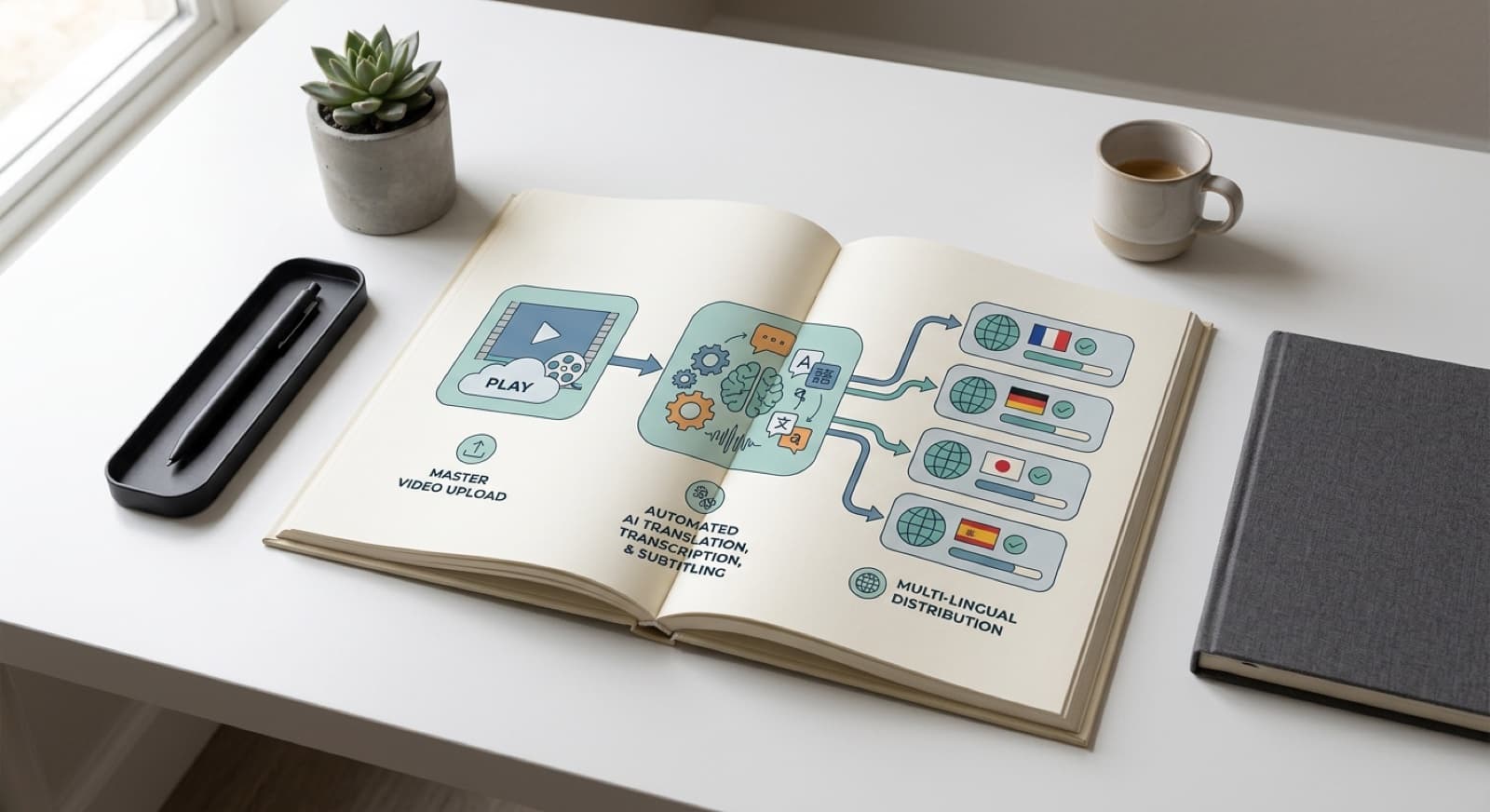
In Kürze
Translating video content no longer requires five-figure studio budgets. Discover how modern creators and brands utilize structured AI workflows, localized subtitles, and human-in-the-loop editing to successfully grow globally at scale.
Inhaltsverzeichnis
- The Strategic Value of Video Content Localization
- The Modern Video Translation Workflow Step by Step
- Establishing Strict Quality Control and Human in the Loop Review
- Comparing Costs: Traditional Studio Dubbing vs AI Powered Localization
- Choosing Your Method: Subtitles, Voiceovers, or Full AI Dubbing
- Scaling Globally with Dictem Studio
- Häufig gestellte Fragen
- Quellen
Wichtige Erkenntnisse
- Traditional studio dubbing can exceed 5000 dollars per hour, whereas modern AI dubbing averages between 5 and 20 dollars per video minute.
- A hybrid approach combining automated AI transcription with human-in-the-loop editing ensures 100 percent translation accuracy.
- Professional localized subtitles cost between 5 and 25 dollars per minute, presenting a budget-friendly option for content teams.
- Successful video translation requires aligning audio speed, cultural adaptations, and visual overlays to maintain a native feel.
The Strategic Value of Video Content Localization
For modern content creators, podcasters, and brand marketing teams, the traditional approach to scaling global reach has always been bottlenecked by production costs. Creating unique audio and video assets for every target market is no longer a viable strategy in a hyper-competitive digital landscape. Instead of duplicating production pipelines from scratch, forward-thinking content teams are adopting a modern localization-first playbook. By translating and re-voicing a single high-quality video or podcast episode, creators can unlock new international markets at a fraction of the cost of traditional studio recording. This methodology allows brands to maximize the lifetime value of their existing media assets while transitionally shifting from local creators to global players.
Expanding Market Reach Without Duplicating Production
The core strategic benefit of video localization is the ability to scale audience footprint without duplicating creative overhead. When a video is localized with multilingual audio tracks, the potential viewership expands exponentially. According to official platform data from YouTube, creators who upload multi-language audio tracks see over 25% of their total watch time originate from viewers watching in a non-primary language[1]. This proves that audiences are eager to consume native-sounding content when the friction of language is removed. For publishers and content teams, this means that a single high-production video can serve five, ten, or even fifty different regions simultaneously, bypassing the expensive process of hiring local actors, renting international studios, or coordinating regional shoots.
Boosting Multi-Language SEO and Global Search Performance
Localization goes beyond simply changing the spoken words; it optimizes the content for global search engines and native recommendation algorithms. Modern platforms like Dictem enable creators to translate video scripts, generate accurate closed captions, and localize metadata. This strategy allows podcasters and marketing teams to implement targeted global growth strategies to establish a dominant footprint in international search results. It is also highly effective for video discoverability, as search algorithms increasingly prioritize native language assets to improve overall user engagement.
Establishing a Unified Global Brand Identity
Maintaining brand trust and narrative consistency across borders is a common challenge for global businesses. Traditional subtitles can often distract viewers and fail to build a deep emotional connection, which makes the strategic choice between dubbing versus subtitles a critical decision for content teams. By using AI-driven voice synchronization and cloning, a brand can keep its original speaker's tone, pacing, and emotional nuance intact across dozens of target languages. This level of personalization significantly influences viewer behavior. Indeed, research shows that 76% of surveyed online shoppers strongly prefer purchasing products when the relevant information is presented in their native language[2]. Providing high-fidelity translated audio ensures that the core brand identity remains unified, professional, and accessible everywhere.
| Metric | Traditional Duplication | AI-Native Localization |
|---|---|---|
| Resource Overhead | High - Requires separate local creators, studios, and actors for every market | Low - Uses one master asset translated into over 100 languages via Dictem Studio |
| Turnaround Time | Weeks or months per localized episode | Minutes or hours through automated workflows |
| Brand Consistency | Variable depending on regional talent quality | Highly consistent as original voice qualities and assets are cloned and retained |
| Production Costs | Multiplied per target market | Fractional incremental cost per additional language |
The Modern Video Translation Workflow Step by Step
Translating video is no longer a manual, siloed process of sending scripts to agencies and waiting weeks. It has evolved into a highly integrated, step-by-step sequence of automation and selective human oversight. By breaking down the process, creators and content teams can scale their reach efficiently, transforming local productions into global assets. For teams looking to scale, establishing a structured framework is the first step toward a successful localization playbook that moves away from disjointed manual efforts.
Step 1: Automated Transcription and Script Preparation
The workflow begins with generating an accurate text transcript of the source audio. Instead of manual transcription, modern platforms use automated speech-to-text engines to create a raw script within minutes. This initial step is critical because any errors in spelling, punctuation, or speaker identification will cascade down to subsequent stages[3]. Advanced workspaces like Dictem Studio handle this by automatically identifying speakers and preparing a clean, timestamped script. In addition to transcript generation, this stage involves preparing the script by stripping out non-verbal fillers and segmenting sentences to match natural reading or speaking rates.
Step 2: Time-Stamped Translation and Cultural Adaptation
Once the script is finalized, the workflow moves to time-stamped translation. Video localization requires more than literal word-for-word translation; it demands cultural adaptation to preserve context. Translated phrases must fit the exact temporal windows of the original video to prevent frustrating lags, which is a key technical challenge solved by modern AI dubbing solutions. This stage involves adjusting sentence structures and lengths so that the translated text matches the original pacing without losing the author's intent or emotional impact[4].
Step 3: Audio Synthesis and Subtitle Rendering
The final stage is turning the adapted translation into the viewer experience. This is achieved through two primary pathways: synthesizing spoken audio or rendering localized subtitles. For audio-focused content like podcasts and courses, synthesizing cloned voices that match the original speaker's tone yields the highest audience retention. For visual-first platforms, rendering synchronized closed captions ensures broad accessibility. Teams must evaluate whether to use subtitles or synchronization depending on their target channel, distribution strategy, and audience behavior[5].
- Upload and Transcribe: Upload the video file to a localized workspace to generate a timestamped transcript.
- Review and Refine: Edit the raw transcript for names, technical terms, and speaker designations.
- Translate and Adapt: Run automated translation with precise temporal constraints to maintain timing.
- Synthesize or Generate Subtitles: Apply voice cloning to generate multi-language audio or render matching subtitle tracks.
- Master and Export: Quality-check the synced output and export the localized video for global distribution.
Establishing Strict Quality Control and Human in the Loop Review
While artificial intelligence has dramatically accelerated translation workflows, relying entirely on fully automated systems can put your brand authority at risk. AI tools excel at processing bulk audio and video at scale, but they lack the cultural context and deep industry-specific vocabulary needed to deliver flawless results. Without a structured quality control framework, small mistranslations or awkward phrasing can alienate global audiences and damage credibility. Integrating a human-in-the-loop review process ensures that your content is both efficient and accurate. By combining the speed of platforms like Dictem Studio with human oversight, media teams, podcasters, and publishers can implement a localization playbook to protect their messaging and scale globally without sacrificing quality.
Correcting Machine Translation Errors in Industry Terminology
Generic machine translation algorithms often struggle with highly specialized industry jargon, technical terms, or branded vocabulary. For instance, in educational videos, corporate training, or niche podcasts, a literal translation of a technical phrase can become entirely nonsensical in another language[6]. Reviewers must carefully check and refine the generated script before it proceeds to the voice synthesis stage. Content creators should establish glossaries of key terms and rely on human editors to verify that regional idioms and professional nomenclature are applied correctly. This step prevents embarrassing errors and ensures your translated video maintains the authority of the original content.
Optimizing Lip-Sync and Audio Pacing
Another critical quality assurance mechanism involves correcting temporal alignment and lip-sync issues. Due to language expansion, translated phrases are often significantly longer or shorter than the original English phrasing. This discrepancy can cause the audio track to fall out of step with the on-screen action, creating a distracting viewer experience. Professional workflows use specialized tools to adjust speech rate, trim pauses, or rewrite sentences slightly to achieve natural pacing. In advanced setups, visual alignment tools modify the speaker's mouth movements to match the translated audio, which is crucial for high-quality video dubbing[7]. Adjusting these elements manually during review ensures that the final localized video looks and feels entirely natural.
Verifying the Emotional Tone of Synthetic Voices
Finally, the emotional delivery of synthesized voices must be verified. While modern voice cloning technology can replicate a speaker's unique vocal signature in multiple languages, raw AI outputs can occasionally sound flat, robotic, or expressively mismatched. For example, an energetic marketing pitch should not sound monotonous in French or Spanish, nor should a somber audiobook narration sound overly cheerful. Editors must review the synthetic audio, adjusting parameters like emphasis, tone, and pacing to match the emotional intent of the original video. This direct human review transforms a standard automated translation into an engaging, emotionally resonant experience that connects with international audiences on a human level[8].
| Localization Challenge | Automated AI Risk | Human in the Loop QA Action |
|---|---|---|
| Industry Terminology | Literal translations that misrepresent technical or branded concepts. | Reviewers edit transcripts, applying pre-approved glossaries before dubbing. |
| Audio Pacing & Sync | Audio tracks that overflow visual scenes due to language expansion. | Editors adjust speech rates and trim pauses to preserve temporal alignment. |
| Emotional Expression | Synthetic voiceovers sounding flat, robotic, or emotionally mismatched. | Directors tweak synthetic emphasis and tone parameters to restore nuance. |
Comparing Costs: Traditional Studio Dubbing vs AI Powered Localization
When brands decide to scale their media reach globally, they face a classic dilemma: how to balance high-quality translation with realistic budget allocations. Traditionally, localizing video content meant managing a complex web of independent contractors, voice agencies, and specialized post-production engineers. Today, AI-powered localization platforms are completely shifting this landscape. By comparing legacy workflows directly against automated technology, publishers can identify the exact points where budgets inflate and where they can find massive efficiencies. Organizations transitioning to AI video dubbing typically see cost reductions of over 90 percent while reducing turnaround times from weeks to minutes[9].
Analyzing Per-Word Human Translation Fees
The first major cost driver in any traditional localization workflow is the script translation. Professional human translation typically costs between $0.08 and $0.30 per word, depending on the complexity of the subject matter and the rarity of the language pair[9]. For an educational series, a masterclass, or an in-depth corporate video containing 10,000 words, translation alone can require an upfront investment of $800 to $3,000 before a single voice is recorded. When translating a single course or podcast episode into multiple target languages, these script fees accumulate linearly, creating a significant barrier to entry for content teams looking to test new global markets.
Calculating Traditional Voice Actor and Studio Rates
Once the script is translated, traditional dubbing requires hiring voice talent and renting professional recording facilities. Voice actors usually charge hourly session rates, project fees, or usage buyouts that can range from hundreds to thousands of dollars per actor. Additionally, physical studio rentals and the expertise of sound engineers and directors typically add $100 to $300 per hour to the bill. Because of these stacked personnel and hardware requirements, professional studio dubbing for high-end productions regularly costs between $5,000 and $15,000 per hour of finished content for each target language[9]. For multi-speaker videos, these expenses compound rapidly, making global distribution cost-prohibitive for all but the largest media networks.
Evaluating Scalable AI-Powered Localization Costs
In contrast, AI-powered systems offer scalable, highly predictable pricing models based on subscription tiers or per-minute consumption rates. Typical AI video localization costs range from $2 to $20 per minute of finished video content, making it highly accessible for podcasters, independent creators, and digital educators[9]. AI-native workspaces like Dictem Studio by Dictem allow users to instantly translate, re-voice, and package material into over 100 languages. This technology features synthetic voice cloning that matches the tone of original speakers, completely removing the need for physical studios, directors, and casting calls. This efficiency lets organizations distribute their entire video library globally rather than limiting localization to a select few high-budget pieces. Content teams can find more context on selecting these platforms by exploring modern localization tools that support these workflows.
| Cost Component | Traditional Studio Dubbing | AI-Powered Localization |
|---|---|---|
| Script Translation | $0.08 to $0.30 per word | Included in software subscription |
| Voice Talent & Studio Hire | $100 to $300 hourly rental plus actor fees | Eliminated through high-quality AI voices |
| Total Project Cost (Per Hour) | $5,000 to $15,000 per finished hour | $120 to $1,200 per finished hour |
| Turnaround Time | Several weeks to months | Minutes to hours with real-time editing |
Ultimately, deciding between traditional studio dubbing and automated systems comes down to budget, speed, and volume. While high-budget commercial campaigns and major cinema releases still rely on human actors to convey intricate emotions, AI-driven platforms provide an unmatched solution for creators who need to publish high volumes of educational, narrative, or promotional media. When balancing your strategy between different formatting options, such as dubbing versus subtitles, the drastically reduced cost of AI dubbing makes localized audio experiences highly competitive. Using a centralized workspace allows publishers to run a practical, hybrid model that scales content globally without breaking the bank.
Choosing Your Method: Subtitles, Voiceovers, or Full AI Dubbing
Selecting the right localization format is the first strategic hurdle when taking video content global. For content teams, podcasters, and video creators, the choice between subtitles, voiceovers, and full AI dubbing is not just a question of budget, but a decision that directly shapes audience engagement, cognitive load, and watch time. Each format serves a distinct purpose, has unique platform advantages, and comes with specific resource demands. To maximize your international reach, you must align your localization choice with your target platform, content complexity, and the viewing habits of your audience.
| Localization Method | Ideal Content Type | Cognitive Load | Viewer Retention |
|---|---|---|---|
| Subtitles | Silent social feeds, short-form video | High (requires split visual attention) | Moderate (higher drop-off on long videos) |
| Voiceovers | E-learning, tutorials, webinars | Medium (original voice remains audible) | High (focused on instructional clarity) |
| Full AI Dubbing | Podcasts, immersive storytelling, films | Very Low (natural listening experience) | Maximal (up to 5x higher watch time) |
Subtitles: Crucial for Silent-Scroll Feeds
Subtitles remain the foundational starting point for content translation, especially on platforms where audio is muted by default. Industry studies indicate that up to 85% of videos on social media feeds are watched without sound, making subtitles absolutely vital for capturing initial attention during a silent scroll[3]. Subtitling is highly cost-effective and provides essential accessibility for deaf and hard-of-hearing audiences. However, relying solely on text-on-screen creates a kognitive split-effect, forcing viewers to constantly switch focus between the visual action and the translated text. While perfect for short-form clips, this reading strain often leads to a major drop-off in engagement during longer videos, making a transition to audio localization necessary for deeper connection.
Voiceovers: Clear and Structured for Educational Content
For instructional, corporate, and educational videos, voiceovers offer a balanced and highly structured alternative. Unlike dramatic dubbing, a traditional UN-style voiceover places a translated audio track over the original speaker, keeping the original background voice slightly audible. This method is exceptionally effective for tutorials, technical webinars, and product demonstrations, where maintaining the authority and presence of the original speaker is key. Creators can use tools like Dictem's Dictem Studio to generate precise, clear multilingual voiceovers in over 100 languages, maintaining perfect synchronization without the need for complex multi-character acting. It delivers maximum informational clarity at a fraction of traditional studio recording costs, ensuring that educational platforms can scale their materials globally without sacrificing instructional quality.
Full AI Dubbing: Immersive Engagement for High-Impact Media
When emotional resonance, narrative immersion, and long-term viewer retention are the primary goals, full AI dubbing is the gold standard. For podcasters, documentary creators, and brands producing high-impact narrative videos, replacing the original audio track completely with localized speech allows the audience to fully focus on the visual storytelling. While traditional studio dubbing was historically reserved for massive budgets, modern AI video dubbing platforms have democratized this process. By analyzing the strategic trade-offs of subtitles vs dubbing, creators frequently find that full AI dubbing raises average view duration by up to 70% compared to subtitled versions because it eliminates reading fatigue[10]. Implementing a complete localization playbook allows content teams to preserve the original speaker's characteristic tone and emotional depth through sophisticated voice cloning, resulting in an immersive experience that feels native to every local market.
Scaling Globally with Dictem Studio
Scaling video content translation is no longer a luxury, but a core growth driver. The global video localization market is projected to reach 6.5 billion USD by 2033, driven by a growing demand from regional audiences who expect native-language content[11]. For brands, podcasters, and content teams, the traditional approach of hiring separate agencies, translators, and voice actors for each target market is too slow and cost-prohibitive. To reach a global audience without operational bottlenecks, teams need a modern localization-first approach that centralizes the entire workflow within a single collaborative environment.
Centralizing Workflows in a Single Hub
Dictem Studio, the flagship AI localization web application from Dictem, replaces fragmented workflows with a cohesive, centralized workspace. Instead of bouncing between transcription software, external translation agencies, and audio editing tools, content creators can manage everything in one place. You simply upload your master video or audio file, and the platform automatically extracts the transcript, translates it, and generates synchronized voiceovers in over 100 languages. This unified hub saves time, prevents data leakage, and keeps all translations, voice clones, and media assets organized in a single repository.
- Automated transcription and multi-lingual translation in over 100 languages.
- Voice cloning that preserves the original speaker's emotional tone and unique vocal characteristics.
- Perfect audio-to-video alignment, replacing traditional, tedious studio adjustments.
- Instant subtitling with automated timing and customizable formatting options.
Streamlining Collaboration with Internal Translators
While AI handles the heavy lifting, professional localization requires human oversight to ensure brand safety, cultural nuances, and accurate terminology. Dictem Studio includes dedicated collaborative workspaces designed to bridge the gap between machine speed and human precision. Content teams can invite internal translators, proofreaders, or local market managers to review and refine the translated scripts before generating the final audio. This hybrid approach ensures that localized media meets professional brand standards without sacrificing speed or budget.
| Workflow Phase | Traditional Studio Approach | Dictem Collaborative Workflow |
|---|---|---|
| Translation Review | Exchanging spreadsheets over email with external linguists. | Translators edit scripts directly in the browser before audio generation. |
| Voiceover Syncing | Manual audio recording and frame-by-frame alignment. | Automated AI voice cloning with automatic time-synchronization. |
| Approval Loop | Days of back-and-forth reviews and manual file transfers. | One-click team sharing and instant asset downloads. |
Seamless Distribution in Over 100 Languages
Once a translation is approved, content teams can instantly export the final media assets in multiple formats. Whether you are distributing multi-language audio tracks on YouTube, launching international podcasts on Spotify, or pushing localized video courses to EdTech platforms, the platform ensures seamless global reach scale globally. Multi-language audio tracks allow you to leverage a single channel to drive massive increased reach instead of fracturing your audience across multiple regional channels.
By establishing this automated yet collaborative workspace, brands and publishers can successfully scale their operations without experiencing a bottleneck in production. Utilizing modern video synchronization and advanced voice cloning ensures that you preserve your brand's unique identity while speaking directly to local audiences across the globe. This structured workflow is what ultimately makes the concept of Create Once, Localize Everywhere a practical reality for scaling organizations.
Häufig gestellte Fragen
How much does it cost to translate video content on average?
Traditional voiceover and studio dubbing can cost upwards of 5000 dollars per hour of finished media. In contrast, modern AI-powered translation and dubbing services range from 5 to 30 dollars per minute, representing an average cost reduction of up to 90 percent.
What is the difference between video translation and video localization?
Video translation is the literal conversion of spoken words from one language to another. Video localization goes deeper by adapting cultural references, idioms, measurements, onscreen text overlays, and audio pacing to fit the cultural preferences of a specific target market.
Why is human-in-the-loop quality assurance necessary for AI video translation?
While AI translation tools are incredibly fast, they can misinterpret brand-specific terminology, specialized industry jargon, or colloquial humor. Having a human review and edit the transcript ensures your translated content remains accurate, professional, and on-brand.
How do you match the timing of a translated voice to the original video?
Modern platforms utilize time-stamping algorithms and speed-matching features. During translation, the text length is adjusted to fit the exact duration of the original phrase, ensuring the synthesized voice aligns cleanly with onscreen mouth movements and visual cuts.
Is subtitling or audio dubbing better for video localization?
Subtitling is highly cost-effective and perfect for social media where up to 80 percent of videos are watched on mute. Audio dubbing is superior for highly immersive content like podcasts, webinars, courses, and narrative videos where audio engagement is critical.
Which tools support scalable content localization for media teams?
Platforms like Dictem with Dictem Studio allow teams to centralize their translation projects. Media teams can manage transcripts, generate natural synthetic voices in over 100 languages, collaborate with translators, and distribute localized files from a single hub.
Quellen
Ready to go global?
Translate, re-voice, and package your content for every language, with Dictem.
Open Dictem Studio