Localizing Course Quizzes with AI Without Destroying the Assessment
Jack Clawson
Dictem Editorial
September 16, 2026
10 min
In short
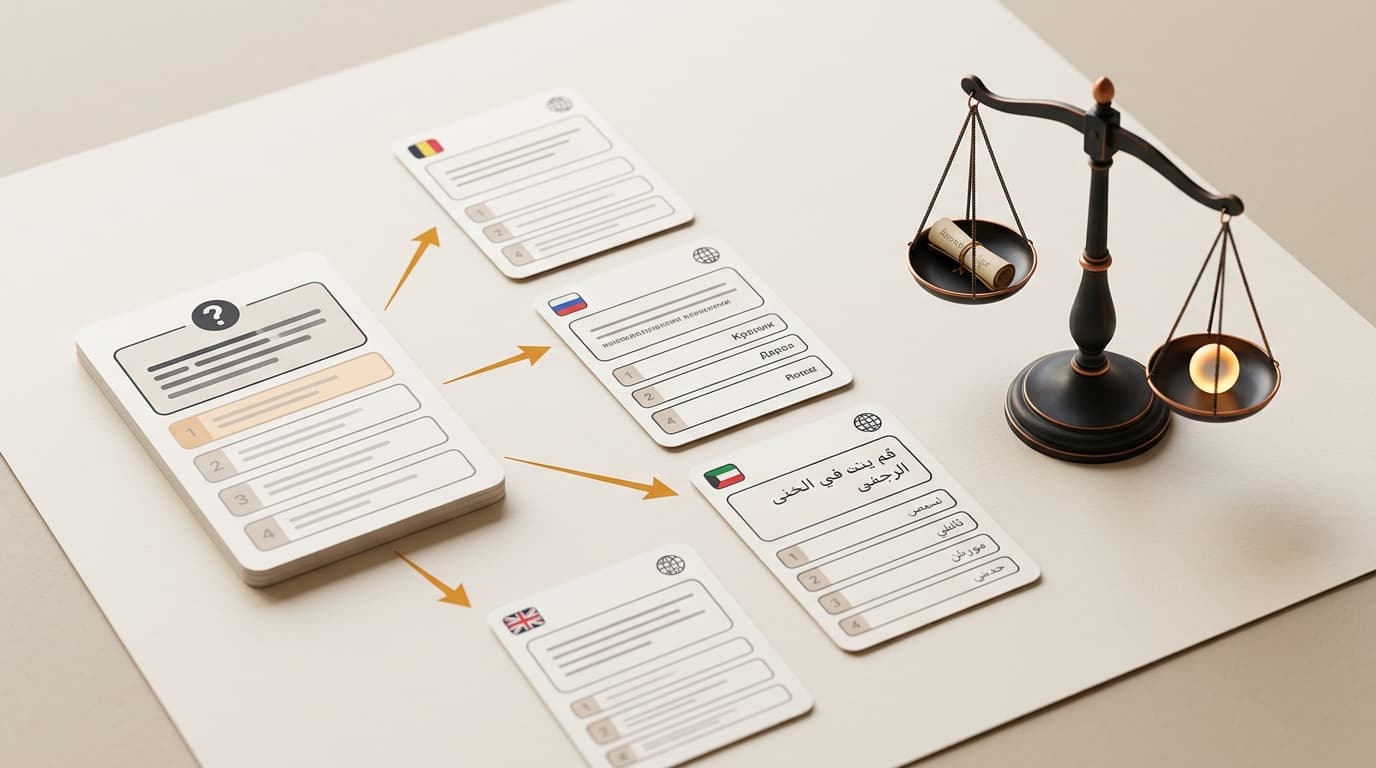
AI dramatically accelerates course localization, but with quizzes and exams it is not style that matters – it is measurement accuracy. This article shows where translation silently destroys assessment results and how to use AI so that all language versions remain fair, equally difficult, and comparable.
Table of contents
Why translated quizzes put assessment at risk
Typical sources of error: distractors, answer hints, text expansion
What AI can already do in exam localization
Where AI reaches its limits
The process: from a translation-ready original to verification
Frequently asked questions
Sources
Key takeaways
In a Groningen study, depending on the exam cycle, 34 to 36 percent of the items in a literally translated exam showed measurable bias
A field study across 91 courses shows: AI-generated exam questions can be comparable to expert-written questions in difficulty and discrimination.
The ITC guidelines define 18 rules in six categories for fair test translation, including double translation and empirical confirmation.
AI may translate, but fairness is only demonstrated through piloting and DIF analysis across the language versions.
Why translated quizzes put assessment at risk
A quiz in an online course is not a block of text but a measuring instrument. The score decides who passes a course, who receives a certificate, and who can add a result to their portfolio. That is precisely why exam questions must not be treated like marketing copy that you simply translate along the way. For a comparison between two language versions to be valid at all, both must measure the same competence. The International Test Commission names this construct equivalence in its guidelines on test translation as a fundamental prerequisite: a poor translation can damage the validity of a test to such an extent that the scores of the two versions can no longer be meaningfully compared.[1]
The technical term for this problem is item bias: a single item systematically favors one group of participants and disadvantages another, even though both possess the same knowledge. How quickly this happens is shown by a study from the University of Groningen. There, students from a national and an international medical program take the same progress test, which for the international variant is translated literally from Dutch into English. Even though a certified medical translator and an English-speaking physician were involved as revisor, the Differential Item Functioning analysis across four consecutive exams showed that, depending on the cycle, 34 to 36 percent of the items exhibited measurable bias.[2]
An item becomes harder to understand in the target text, even though the material being tested has not changed.
Participants fail because their language skills are insufficient, not because their competence is lacking.
Scores from different language versions are no longer comparable, even though the platform treats them identically.
The damage remains invisible: without targeted analysis, nobody notices that the measuring instrument is skewed.
For EdTech teams and course creators, this is the central danger: the test suddenly measures language skills instead of subject-matter competence. The result is not a slightly less accurate assessment but a systematically wrong one, and it hits precisely the learners that localization was actually meant to reach.
Typical sources of error: distractors, answer cues, text expansion
Bias does not arise as an abstract quality problem, but through concrete, identifiable mechanisms within the item itself. Anyone who knows these mechanisms can check for them deliberately during translation, instead of hoping for the best with the finished language version.
| Source of error | What happens | Impact on measurement |
|---|---|---|
| Linguistic features of the item | Passive constructions, unequal length of the key and distractors, or grammatical congruence drive the difficulty. The ITC guidelines require that the correct answer be roughly the same length as the distractors and that grammatical cues not give away the solution | The difficulty shifts because the translation destroys or newly creates the cue structure of the original |
| Answer cues in the target text | The translated item stem suddenly mentions that a patient is going to the dentist, thereby revealing the medical specialty being asked about. Or a well-meaning explanation makes the correct answer recognizable | Experienced participants read the solution out of the wording, and the item becomes easier than intended |
| Text expansion | Translations from English into languages such as French or Spanish typically run 15 to 30 percent longer, and into German by 35 percent or more | Answer options spill onto new lines, layouts break, and length alone makes individual options more conspicuous |
| Item flaws | Weaknesses lurking in the item already in the original are amplified or newly introduced by the translation. The Groningen study attributes bias in part to such item characteristics as item flaws, length, and the number of answer options | Stronger participants are penalized more than weaker ones, and the error effect often goes undetected psychometrically |
What is striking about this list: none of these sources of error has anything to do with translation quality in the classical sense. A linguistically flawless, even elegantly phrased translation can contain all four problems at once. That is why the question of the best translation tool is not enough; the decisive question is who re-examines the measuring instrument itself after translation.
What AI can already do for exam localization
After all these risks, it is worth looking at the other side of the ledger, because in this field AI has long been more than just a source of error. The empirical situation shows that machine translation and automated scoring in exam contexts now reach a remarkably solid level.
One piece of evidence comes from international educational assessment research: in a study on TIMSS 2019, freely formulated student responses from eight countries and six languages were harmonized via machine translation, including ChatGPT, and then scored automatically. The automated scoring performed comparably to human scoring, and the psychometric properties of the items also remained similar.[4] For large-scale multilingual exams, this is a strong signal that the technical pipeline fundamentally works.
The second signal concerns question generation itself. The field study "Assessing the Quality of AI-Generated Exams" examined 91 courses at dozens of US colleges with nearly 1,700 students and evaluated the multiple-choice questions used via item response theory.[5] The AI questions were comparable in difficulty and discrimination to items written by experts for standardized exams.
Context prompting: the simplest lever
Between these findings and practice lies a simple, immediately actionable lever: context prompting. Instead of translating individual quiz questions in isolation, you give the model the item stem, the answer options and, ideally, the thematic context of the course in the prompt. In the TIMSS study, ChatGPT was instructed in exactly this way to translate answers while taking the English item stem into account, and the translations produced this way yielded the best automated scoring.[4] For a quiz, this means: the question should never go into the translation box alone, but always together with the subject context in which it is asked.
The realistic division of roles, then, is this: AI translates, generates and accelerates, while humans verify difficulty and fairness. The next two sections sharpen both sides of this arrangement.
Where AI reaches its limits
The limits of the tool can be stated precisely, and in education they are more serious than in marketing. The biggest risk is hallucination: AI models produce content that sounds plausible but is factually wrong. In educational contexts this weighs especially heavily, because learners treat exam content as established knowledge and rarely cross-check it. The field study on AI-generated exams therefore relies on an iterative process of generating, critiquing and revising questions, rather than deploying model outputs directly.[5] In a quiz this means: an incorrectly translated or hallucinated factual statement is not merely read, but learned as exam-relevant truth.
The second limit is structural: pure text-in-text-out translation knows neither the cultural context of the target audience nor the didactic intent of the item. Whether an example from healthcare works in the target culture, whether an abbreviation is common there, and whether the translation hits the intended level of difficulty – all of this is decided outside the text snippet the model sees. This is precisely why guideline TD-1 calls for a team that jointly covers language, culture, subject-matter and assessment expertise.[1] The provider cApStAn, which specializes in assessment localization, describes a collaborative model in which linguistics and subject expertise come together and contested cases are moderated.[6]
Hallucination in the feedback text: The model adds a rationale to the correct answer that is factually wrong. Countermeasure: feedback and explanation texts are approved individually by the subject editors, not just the question.
Cultural context in the item stem: A task calculates in gallons, or references a US holiday or a school system the target audience does not know. Countermeasure: document units of measurement, names and institutions per language version as adaptation decisions, not as translations.
Subject context in terminology: 'Belastung' can mean load, stress or financial burden, and only one variant matches the construct being tested. Countermeasure: a maintained terminology list per course, to which the model is bound.
Assessment expertise in distractor design: The model translates a terse distractor more elaborately than the key answer, making it more attractive. Countermeasure: cross-check the length and parallelism of all options after translation.
The process: from a translation-ready original to verification
A practical workflow can be derived from the ITC guidelines. The second edition of the Guidelines bundles 18 guidelines into six categories, from preconditions through test development to empirical validation.[1] For a course operation, this can be turned into a compact sequence that can be run through per language version.
Check the translatability of the original: Before the first item is translated, a Translatability Assessment of the original is worthwhile. cApStAn recommends exactly this upstream approach to catch problems before they migrate into every language version.[6] Items with culture-specific examples, wordplay or extremely long key answers are rewritten now – once instead of ten times.
Double translation with independent reconciliation: Instead of a single translation, two independent versions are produced and reconciled by a third person or an expert panel. This double-translation and reconciliation procedure is anchored in the ITC guidelines (TD-2) and is practiced on a large scale at PISA.[1] AI can supply both initial translations here; the reconciliation remains human.
Segment-by-segment verification of the target version: The finished language version is checked item by item against the original, using standardized intervention categories such as omission, addition or shift in meaning. This makes it documentable where a translation has changed the difficulty, instead of the verdict resting on a general impression.
Piloting and empirical validation: The new language version first runs on a small sample before it makes pass/fail decisions. How these response data are evaluated is shown in the next section.
Frequently asked questions
Can I simply translate quiz questions into other languages using AI?
For lesson texts, that is often enough – for exam questions, it is not. As the first section shows, even a professionally translated and technically reviewed exam contains measurable item bias in a considerable share of its items. Whoever translates a quiz is translating a measurement instrument and must review difficulty and fairness for each language version.
What is item bias or DIF in translated exams?
DIF (Differential Item Functioning) means that test takers with the same ability have different chances of answering correctly depending on the language version. It is measured through psychometric analysis of the response data, for example based on Item Response Theory. Affected items are adjusted, removed, or rewritten.
How much longer do texts become through translation?
Significantly longer than most quiz layouts anticipate: the table above gives the order of magnitude, and for German it sits at the upper end. This space must be planned in from the start for layouts, buttons, and answer options – otherwise layouts break, and overly long distractors can additionally give away the correct answer.
Are AI-generated or AI-translated exam questions as good as human-created ones?
They can be. The US field study discussed in the article comes to psychometrically comparable results for AI-generated questions and expert-written tasks. The prerequisite is a structured process of generating, evaluating, and revising the questions.
Do I have to pilot every language version of a quiz?
For high-stakes exams, yes: that is precisely why the process section above ends with piloting and empirical testing of equivalence. For low-stakes course quizzes, a sample plus a DIF check is often enough, once enough responses per language are available.
What role remains for humans when AI translates?
Humans provide the subject-matter and cultural context, maintain the terminology, and verify the translation segment by segment. The section on the limits of AI describes which competencies this team must cover.
What does localizing exams cost compared to normal course text?
More: on top of pure translation come the translatability review of the original, adaptation notes per item, segment-by-segment verification, and piloting. It pays off, because fixing an exam whose bias only becomes apparent after going live is far more expensive than localizing it properly once.
Sources
[1] intestcom.org – https://www.intestcom.org/files/guideline_test_adaptation_2ed.pdf
[2] pmc.ncbi.nlm.nih.gov – https://pmc.ncbi.nlm.nih.gov/articles/PMC6715902/
[3] argotranslation.com – https://www.argotranslation.com/blog/text-expansion-during-translation
[4] link.springer.com – https://link.springer.com/article/10.1186/s40536-024-00199-7
[5] arxiv.org – https://arxiv.org/abs/2508.08314
[6] capstan.be – https://www.capstan.be/test-adaptation
Ready to go global?
Translate, re-voice, and package your content for every language, with Dictem.
Open Dictem Studio