Podcast Translation: The Complete Guide for 2026
Sophie Tran
Audio & Voice
June 1, 2026
16 min
In short
Ready to expand your podcast's global footprint? Our complete 2026 guide breaks down the latest in AI voice cloning, platform integrations, and localized dubbing workflows to help you reach millions of new listeners in their native languages.
Table of Contents
- The Multilingual Imperative: Reaching 619 Million Listeners in 2026
- Subtitles vs. AI Voice Dubbing: Choosing Your Localization Method
- The Technology Powering Modern AI Voice Cloning
- Native Platform Translation: Spotify's AI Voice Initiatives
- Building an Efficient Podcast Localization Workflow
- Literal Translation vs. Cultural Transcreation
- Frequently Asked Questions
- Sources
Key Takeaways
- Global listenership is projected to reach 619.2 million in 2026, making multilingual distribution a vital channel for growth.
- AI voice cloning technology is growing at a 26.1% CAGR, enabling highly natural and nuanced translated audio.
- Major audio platforms like Spotify are actively piloting host-voiced AI translation to expand global accessibility.
- Successful localization relies on cultural transcreation rather than literal, word-for-word translation to engage local audiences.
The Multilingual Imperative: Reaching 619 Million Listeners in 2026
The global audio landscape is undergoing a massive shift. While podcasting was once dominated by English-speaking markets, the medium has grown into a truly international phenomenon. By 2025, the global podcast audience surpassed 584.1 million listeners, representing a steady 6.83% year-over-year growth rate[1]. As we move through 2026, this trajectory is projected to push the total addressable audience past 619 million. For content teams, publishers, and creators, this rapid expansion signals that a single-market strategy is no longer sufficient to sustain long-term growth. Relying solely on your primary language means leaving millions of potential subscribers on the table.
Tapping into High-Growth Regional Markets
To capitalize on this expansion, creators must look beyond their domestic borders. While the United States remains a highly lucrative market with 158 million monthly listeners, massive audiences are thriving in regions like Latin America, Asia, and Europe[1]. Countries such as China, Brazil, and Mexico represent some of the fastest-growing podcast communities in the world. Accessing these markets requires a structured content localization framework, allowing audio assets to be adapted for regional nuances without starting production from scratch.
| Country | Monthly Podcast Listeners |
|---|---|
| United States | 158.0 million |
| China | 117.1 million |
| Brazil | 51.8 million |
| Mexico | 27.5 million |
| Germany | 22.1 million |
The transition to a multi-language catalog does more than just increase download numbers. It unlocks entirely new monetization channels, attracts regional advertisers, and establishes brand presence in unsaturated markets. In 2026, the standard for podcast translation has evolved from basic text transcripts to sophisticated, AI-driven voice cloning and localized dubbing. Using advanced tools like Dictem's Dictem Studio, creators can now translate and re-voice their episodes in 84 languages. This approach preserves the unique tone, emotion, and vocal characteristics of the original speakers, enabling true global growth with minimal production friction.
Subtitles vs. AI Voice Dubbing: Choosing Your Localization Method
When expanding your show to international markets, you must decide how your global audience will consume your content. In 2026, the baseline expectation for accessibility has shifted. Listeners no longer want to just translate their favorite shows through manual reading; they expect seamless, localized experiences that fit how they naturally consume media. Content teams, audiobook publishers, and podcasters must choose between text-based transcripts, video-first subtitles, and full synthetic voice dubbing. Each approach carries unique trade-offs in terms of listener retention, production effort, and platform compatibility.
The Baseline: Text-Based Transcripts
Text-based transcripts are the oldest and most straightforward way to translate your podcast. While they are highly valuable for search engine optimization and basic accessibility, their ability to drive real listener engagement is limited. While platforms like Spotify now provide native, auto-generated transcripts for a growing number of shows, these transcripts are primarily text-only files that require active reading[2]. If your goal is to and build an active, loyal subscriber base in another country, relying solely on text-based translations will not convey your unique performance, humor, or emotional nuances.
The Midpoint: Video Subtitles and Captions
For creators publishing video podcasts on platforms like YouTube or Spotify Video, subtitles and automated captions provide a practical middle ground. Translated subtitles allow you to keep your original audio track while providing text overlays in multiple languages. This is highly effective for social media channels where users frequently scroll with their sound turned off. However, subtitles have a major drawback: they completely eliminate passive listening. The core appeal of the podcast format is that people can listen while driving, cooking, or exercising. Forcing users to stare at a screen to follow your translated text defeats the primary benefit of audio-first content.
The Gold Standard: AI Voice Dubbing
To deliver a truly immersive experience, modern creators are turning to AI voice dubbing and voice cloning. This method translates the spoken text and re-voices it using high-fidelity synthetic voices that match the original speaker's tone, pacing, and emotional delivery. This enables creators to publish a fully multilingual podcast that preserves their unique audio brand. By choosing advanced localization tools, you can handle translation and synchronized re-voicing in 84 languages. For instance, Dictem's Dictem Studio allows independent podcasters and enterprise media teams alike to scale their audio content globally without the massive costs and delays of traditional recording studios, maintaining an authentic connection with global listeners.
| Method | Engagement Level | Passive Listening Support | Platform Compatibility | Relative Cost & Effort |
|---|---|---|---|---|
| Transcripts | Low (requires active reading) | None | Universal (blog, podcast feeds) | Very low |
| Subtitles & Captions | Medium (visual-dependent) | None (requires visual focus) | Video platforms only (YouTube, Spotify Video) | Low to medium |
| AI Voice Dubbing | High (native emotional connection) | Full (true eyes-free listening) | All audio and video directories | Medium (highly scalable via AI) |
The Technology Powering Modern AI Voice Cloning
The rapid expansion of the global localization market is driven by immense technological progress, with the AI voice cloning market projected to grow at a compound annual growth rate (CAGR) of 26.1% from 2023 to 2030[3]. For content teams and podcasters, this technology represents a massive shift away from rigid, expensive studio recordings toward flexible, automated production. Modern voice replication enables creators to scale their presence internationally without spending hundreds of hours re-recording episodes in foreign tongues. Platforms designed for high-end audio distribution use these advancements to help creators execute an efficient podcast translation workflow that sounds indistinguishable from a native speaker.
How Voice Matching Algorithms Capture Speaker Identity
At the heart of modern voice cloning are deep neural networks that analyze the unique acoustic characteristics of a speaker's voice. Unlike early text-to-speech engines that sounded robotic, modern systems extract high-dimensional vocal embeddings. These embeddings capture vocal elements such as timbre, pitch fluctuations, and unique accent patterns. When localizing a podcast or audiobook, the AI overlays these embeddings onto the target language's phonetic script. This ensures that when a French or Spanish version of an episode is generated, the voice retains the host's recognizable identity. Implementing this technology through advanced AI voiceovers allows audio publishers to maintain a cohesive brand voice across multiple distinct global territories.
Preserving Emotional Timing and Intonation
Translating a podcast is not merely about exchanging words; it requires preserving the emotional resonance, dramatic pauses, and conversational rhythm of the original recording. Modern AI-driven dubbing pipelines utilize zero-shot voice cloning and advanced prosody modeling to align synthetic speech with original timing. The system maps the speaker's emotional state, adapting the speed and inflection of the translated audio to match the excitement, curiosity, or solemnity of the source. Content teams utilizing multilingual podcasting tools can thus maintain the exact narrative pacing of their original show, preventing localized tracks from sounding detached or artificial.
| Feature | Traditional Studio Dubbing | Modern AI Voice Cloning |
|---|---|---|
| Setup Time | Weeks or months to source talent and book studios | Minutes via automated browser-based processing |
| Cost Scale | Expensive per-language rates and voice actor fees | Highly cost-effective subscription-based pricing |
| Voice Consistency | Requires hiring separate actors for every market | Replicates the original host's voice across all languages |
| Delivery and Pacing | Manual editing and manual re-recording alignment | AI-driven prosody and emotional timing matching |
By integrating these sophisticated neural networks into centralized platforms, professional creators can automate what used to be an intricate engineering pipeline. For instance, Dictem's Dictem Studio leverages these exact breakthroughs to handle translation, voice cloning, and emotional synchronization in 84 languages. Instead of treating localization as an afterthought, content teams can implement a comprehensive localization playbook to publish translated content alongside their primary feed. This seamless approach ensures that your message reaches new target markets instantly, preserving both the high synthetic speech accuracy and the deep human connection that makes podcasting such a powerful medium.
Native Platform Translation: Spotify's AI Voice Initiatives
As podcasting matures, major distribution platforms are integrating native translation directly into their syndication channels. The most notable milestone in this shift is Spotify's voice translation pilot, which was launched to bridge the language gap for creators without requiring them to re-record their episodes manually[4]. By embedding translation technology directly into the listening environment, platforms aim to make multilingual podcasts an automatic, default feature of global distribution.
The pilot features prominent creators such as Lex Fridman, Dax Shepard, and Steven Bartlett, translating selected catalog episodes into languages including Spanish, French, and German[4]. Developed in collaboration with OpenAI's voice generation technology, the tool matches the original speaker's distinctive style and speech characteristics[4]. This ensures that the translated audio sounds personal and natural rather than resembling a robotic voiceover.
Unlocking Global Ad Revenue
For podcast networks and content teams, native platform translation is not just an engagement tool but a significant monetization opportunity. By translating episodes into multiple languages, networks can dynamically serve localized advertisements to listeners in different regions, expanding the addressable market for sponsors. Instead of managing multiple RSS feeds or paying local voice actors for every market, a single master feed can serve localized ad spots, maximizing the revenue potential of global distribution structures.
The Future of Platform-Native Dubbing
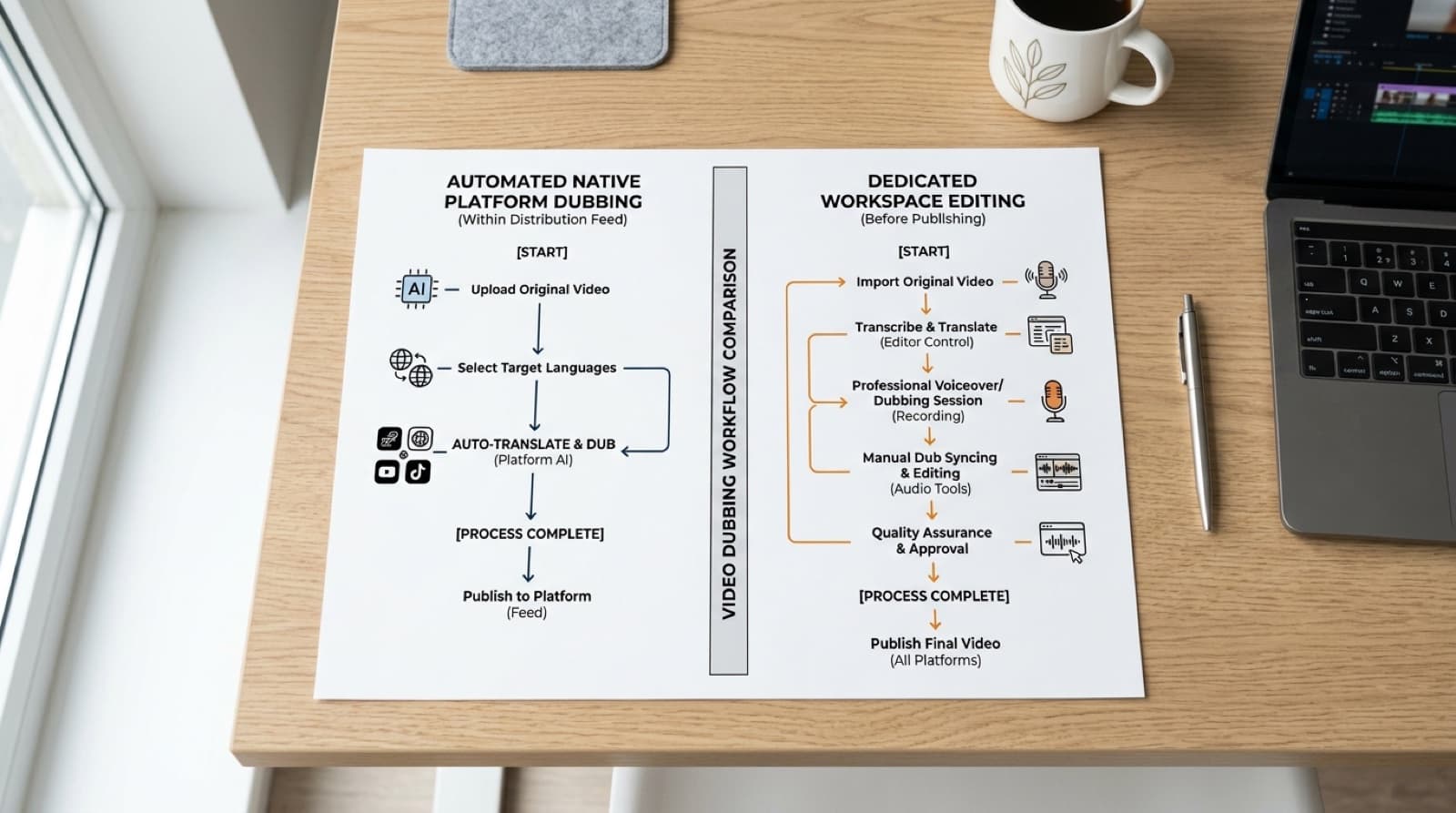
Despite the convenience of platform-native initiatives, professional content teams often face distinct limitations. Native tools typically lock creators into a single distribution platform, meaning a translation generated on one channel cannot be easily exported to YouTube, Apple Podcasts, or audiobook networks. To maintain absolute creative control over translation accuracy, pronunciation, and multi-channel publishing, professional creators rely on dedicated workspaces like Dictem's Dictem Studio to refine their audio before syndication.
| Feature | Platform-Native Translation | Dedicated AI Workspaces |
|---|---|---|
| Distribution | Locked to a single hosting platform | Exportable to all directories, video networks, and sites |
| Editing Control | Automated translation with no manual fine-tuning | Full timeline control, translation editing, and manual timing adjustments |
| Multi-Format Output | Supports audio podcasts only | Supports audio, video localization, transcripts, and social media clips |
As the ecosystem matures, native initiatives will continue to lower the barrier to entry for international audiences. However, podcasters and media networks looking to build a true multi-platform presence will benefit from a hybrid approach: using platform features for immediate reach while leveraging advanced localization workflows to ensure their brand voice remains consistent across every touchpoint.
Building an Efficient Podcast Localization Workflow
Scaling a podcast globally in 2026 requires moving away from fragmented, manual workflows. In the past, translating a show meant coordinating between freelance translators, foreign voice actors, and multiple audio engineering studios. This high-friction approach made consistent, multi-language releases almost impossible for independent creators and small content teams. By adopting an integrated, AI-native workspace like Dictem Studio, creators can consolidate transcription, voice cloning, and audio mastering into a single workflow. Streamlining this process is key to successfully executing your overall strategy for content localization without overwhelming your production staff.
Transcription and Script Alignment
An efficient localization workflow always starts with transcription. High-quality automated transcription transforms the raw speech of your source episode into a time-coded transcript. While Spotify automatically generates word-level transcripts for search and basic reading, these native features do not help you produce translated audio[2]. Editing this master transcript first is a crucial step when translating podcasts, as it allows you to correct brand names, technical terms, and colloquialisms before any translation begins. Generating a clean, structured transcript ensures the translation engine maps perfectly to your original pacing.
Executing Voice Synthesis and Cloning
The core of the localized dubbing process involves synthetic voice generation. In 2026, audiences expect high-fidelity audio that preserves the original host's performance, cadence, and emotion. Advanced voice cloning technology allows you to build a single voice profile from a short sample, which can then be used to synthesize speech in 84 languages. This technological shift enables creators to consistently distribute multilingual podcasts while maintaining their authentic voice and branding across borders. It completely replaces the generic, robotic voiceovers of the past with a natural, emotive listening experience that mirrors the original performance.
- Upload and Transcribe: Import high-resolution audio files into Dictem Studio to instantly generate precise, time-coded source transcripts.
- Refine and Localize: Edit the source text to correct specialized terminology and cultural nuances before initiating translation.
- Clone and Synthesize: Use voice-cloning algorithms to clone host voices, generating localized tracks in multiple target languages while preserving emotional delivery.
- Standardize and Package: Integrate background music, adjust audio ducking, and apply mastering settings to output high-quality, platform-ready audio files.
Standardizing Sound Design and Distribution
The final stage of the pipeline involves standardizing your post-production audio settings and preparing the final files for global distribution. To deliver a professional listening experience, synthesized vocal tracks must be properly balanced against original background tracks, sound effects, and transitions. Once the master audio is polished, the final step is choosing your publication strategy. For maximum localized discoverability, it is highly recommended to publish your translated episodes to separate, dedicated RSS feeds for each market[2]. Implementing this structured approach ensures a successful international podcast release that helps your show scale rapidly in local search directories.
Literal Translation vs. Cultural Transcreation
For global content creators, the transition to international podcasting represents a fundamental shift from word-for-word translation to cultural transcreation. When localizing audio content, relying on simple literal translation can ruin a great show because idioms, sarcasm, and metaphors do not translate directly. For instance, a joke that gets a laugh in New York might be met with total silence in Hamburg. Semantic understanding is the modern standard of high-quality content localization. In 2026, advanced localization platforms focus heavily on semantic models that interpret speaker intent and preserve context, rather than just delivering word-for-word vocabulary[5].
Adapting Humor, References, and Idioms
Humor is notoriously difficult to translate. A literal translation of a culturally specific reference often results in a flat, awkward delivery. This is where transcreation becomes essential, as it recreates the original concept using cultural equivalents that resonate with local audiences. For example, replacing a baseball metaphor with a soccer reference for European listeners makes the content instantly relatable. Using specialized localization systems like Dictem Studio allows creators to adjust their scripts and map these cultural parallels, ensuring the final voiceover or cloned voice sounds natural, emotionally resonant, and engaging.
| Comparison Aspect | Literal Translation | Cultural Transcreation |
|---|---|---|
| Primary Goal | Converting text word-for-word from source to target | Re-creating the emotional impact and intent |
| Handling of Idioms | Translated directly, which often loses all meaning | Replaced with localized cultural equivalents |
| Audience Resonance | Can sound clinical, foreign, or confusing | Feels natural and native to the local listener |
Navigating Regional Speech Regulations
Beyond cultural nuances, legal and speech regulations are a major factor when publishing podcasts globally. Different regions enforce strict rules regarding profanity, commercial disclosures, and politically sensitive content. A localized podcast must respect these local guidelines to avoid platform bans or distribution issues. By utilizing a structured podcast translation workflow, creators can preview and adapt transcripts for regulatory compliance before final voice generation. Staying updated on platform regulations is essential for cross-border reach, and you can follow Dictem's updates and global expansion strategies on their official LinkedIn profile to keep your content pipeline fully compliant.
Frequently Asked Questions
Can I translate my podcast into other languages using my own voice?
Yes, modern AI voice cloning tools, such as Dictem's Dictem Studio, allow you to translate your audio while maintaining your unique vocal identity. By analyzing your original recordings, the AI generates localized audio in dozens of languages that retains your tone, accent, and emotional delivery.
What is the difference between podcast translation and transcreation?
While translation focuses on converting words literally from one language to another, transcreation adapts the content's underlying message, humor, idioms, and cultural references. This ensures that your podcast feels native and engaging to listeners in specific regional markets.
How fast is the global podcast audience growing?
The global podcast audience is expanding rapidly, with projections estimating that there will be over 619.2 million monthly listeners worldwide by the end of 2026. This massive growth represents a major opportunity for creators who localize their content.
How much does the AI voice cloning market grow annually?
The AI voice cloning and speech synthesis market is highly active, growing at a compound annual growth rate (CAGR) of 26.1%. This expansion is driving rapid technological improvements in translation naturalness and real-time dubbing.
Does Spotify offer native translation features for podcasters?
Spotify has been piloting an AI Voice Translation feature with select top podcasters. This technology replicates the original host's voice in translated versions, paving the way for wider platform-level translation features for creators in the future.
Is AI-generated podcast translation accurate enough for professional networks?
Yes, modern AI speech translation platforms deliver excellent accuracy. However, for professional media networks, a human-in-the-loop workflow is recommended. This involves using AI for fast translation and voice synthesis, followed by professional editing to ensure perfect cultural nuance.
What is an AI podcast translator?
An AI podcast translator transcribes an episode, translates the script, and re-voices it in the target language with voice cloning, so the episode keeps the host's tone instead of sounding dubbed. Dictem's podcast translator does this end to end and publishes the localized episode straight to your feed.
Sources
Ready to go global?
Translate, re-voice, and package your content for every language, with Dictem.
Open Dictem Studio