YouTube: Multilingual Audio Tracks or Separate Channels?
Jack Clawson
Dictem Editorial
September 16, 2026
13 min
In short
Multilingual audio tracks and separate channels are both valid routes to an international YouTube audience, but they solve different problems: audio tracks boost an existing signal quickly and affordably, while dedicated language channels build local search rankings, communities and revenue streams. This article compares both strategies in terms of the algorithm, visibility and effort, and shows when combining the two is the strongest solution.
Table of contents
Two routes to multilingual content: audio tracks and separate channels at a glance
Algorithm and reach: one flywheel or several engines
Strengths of audio tracks: speed, back catalogue and simple management
Limits of audio tracks: local search, community and quality
When separate channels are the better choice
Decision guide: assessing channel size, resources and goals
The hybrid strategy: combining channels and audio tracks
Frequently asked questions
Sources
Key takeaways
For videos with multilingual audio tracks, over 25% of watch time comes from views in the non-primary language (YouTube).
MLA videos rank in local search under the original URL; separate channels can dominate local search results.
Poor dubbing is a real risk: in a test, an AI dub caused watch duration to collapse from 5:19 to 1:22 minutes.
Hybrid pays off: cross-seeding dubbed versions across multiple channels delivered on average 45% more views.
Rule of thumb: audio tracks amplify existing signals, separate channels build new audiences and revenue streams.
Two routes to multilingual content: audio tracks and separate channels at a glance
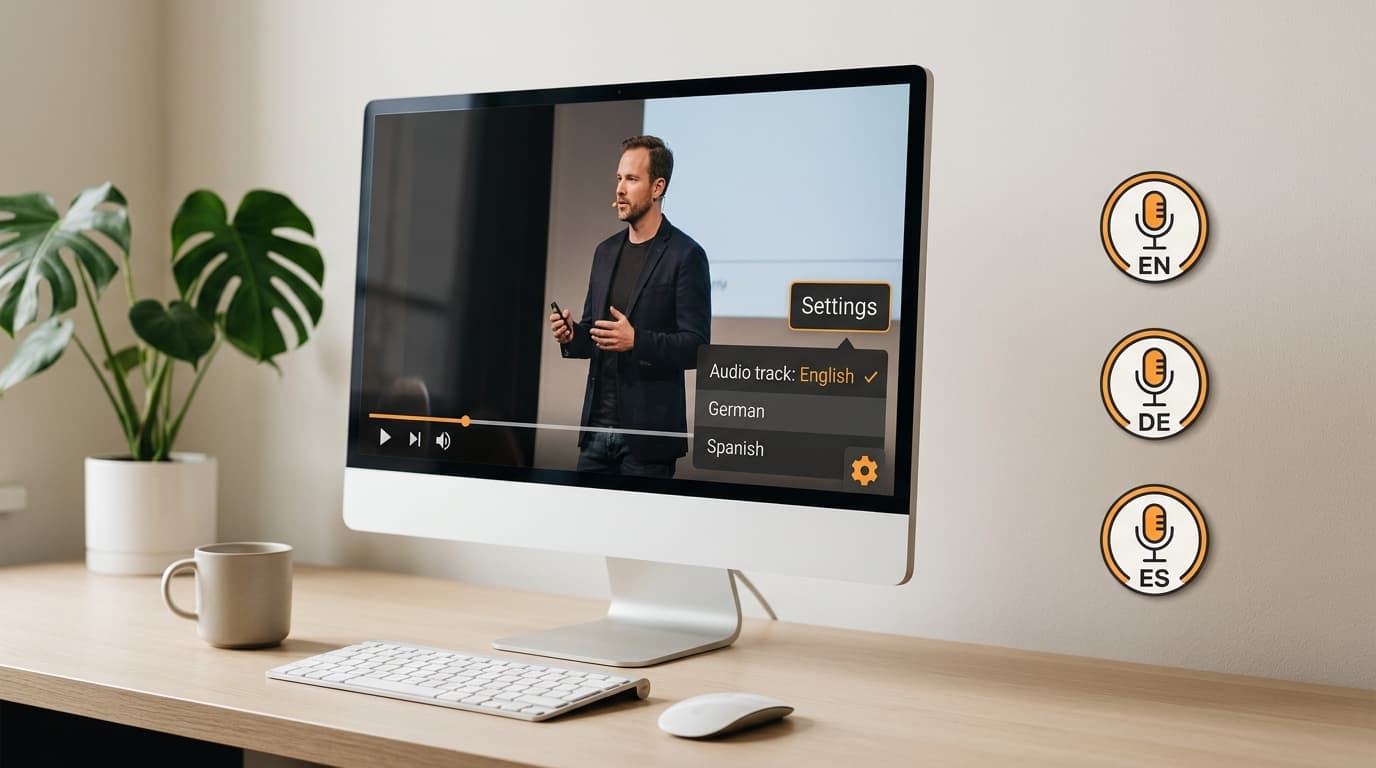
Anyone who wants to grow internationally on YouTube today faces two fundamentally different building-block options. The first is multilingual audio tracks, often abbreviated as MLA (Multi-Language Audio): the creator uploads additional, professionally dubbed audio tracks for a single video, and YouTube plays them automatically in the viewer's preferred language. The video itself remains the same – same URL, same channel, same comments. The second option is separate channels: a complete, standalone channel per language, with its own titles, thumbnails, metadata, community posts and its own upload routine.
YouTube opened up the audio track mechanics to all creators in September 2025, after a two-year pilot programme with a small group of channels.[1] Everything is set up in YouTube Studio: under the Languages menu item, you upload a pure audio file in the target language, which needs to be roughly as long as the video. Importantly: YouTube does not create these tracks automatically – the creator must record or produce the dubbing themselves.[2]
Multilingual audio tracks run on a single video and are played by default in the viewer's preferred language, which YouTube determines from their watch history.[2]
Separate channels are complete, standalone channels per language with their own branding, their own community and their own monetization.
The feature was opened up to millions of creators in September 2025 after a two-year pilot.[1]
Over 90% of YouTube's audience prefers a language other than that of the creator, so the potential beyond one's own native language is correspondingly large.[3]
Both routes lead to multilingual viewers, but they serve different mechanisms of the platform. The question of which approach is right is not decided in general terms, but along four dimensions: how the algorithm weighs signals, how local search works, how a community can be built, and what monetization ultimately results. This article compares both options along exactly these lines.
Algorithm and reach: one flywheel or several engines
The most important structural difference lies in where the views flow. With multilingual audio tracks, every view, regardless of audio language, lands on the same URL. YouTube sees a single video that accumulates watch time from Spanish-, Arabic- and Indonesian-speaking audiences simultaneously. All signals bundle into a single recommendation signal – a flywheel that spins faster with each additional language. YouTube reports that for creators with audio tracks, on average over 25% of watch time came from views in a language other than the primary one.[4]
| Factor | Multilingual audio tracks | Separate channels |
|---|---|---|
| Algorithm signals | Bundled on one URL, one flywheel | Split, but growing independently per market |
| Local search | Ranks only under the original URL | Native SEO per language can dominate local search |
| Community | None in the target language | Comments, polls and posts in the local language |
| Regional advertising deals | Difficult to structure | Direct and possible by default |
Separate channels split this signal, but in return build independent recommendation graphs per market. The Jason Vlogs example shows how far this can go: the English main channel counts around 46 million subscribers, plus standalone channels with 9 million in Hindi and 8 million in Spanish. The localized channels did not cannibalize the main channel – they unlocked audiences the English channel would never have reached algorithmically.[5] That is because YouTube's recommendation system does not cross language markets voluntarily.
For your own decision, one question above all is relevant: Is there already a signal in the target market? Anyone who already sees views, comments or search queries from a language region in YouTube Analytics has a base that can be amplified. Anyone starting from zero there first has to create demand – and a standalone presence in the target language achieves that far more reliably.
Strengths of audio tracks: speed, back catalog and easy management
The biggest lever of audio tracks is the back catalog. Synchronized tracks can be added to existing videos without the videos having to be re-uploaded. Every old video thereby instantly becomes a recommendation candidate in the target language – no new indexing, no waiting time.[5] For channels with a large archive, this is a reach lever that separate channels cannot offer in the same way, because there each language has to be indexed from scratch again.
Jamie Oliver's channel tripled its views through multilingual audio tracks.[4]
Mark Rober publishes an average of over 30 language versions per video so his community can watch simultaneously from Seoul to São Paulo.[4]
YouTube recommends as a best practice to focus on one or two languages and synchronize them in depth.[2]
Those with the resources should have half or more of their existing catalog synchronized so new viewers can discover the channel more easily.[2]
Translated titles and descriptions are taken into account by YouTube's search systems, so viewers can also find the video via search terms in their own language.[2]
The second advantage is management. One channel means one analytics overview, and YouTube Analytics breaks down views and watch time by audio language. This makes it possible to see which language markets are actually generating demand before investing in more.[2] For studios and networks producing dozens of videos per month, that means: no additional editorial operation, no multiple channel maintenance, no fragmented reporting streams. All performance stays in a single dashboard, with a clear breakdown of which language is contributing what.
The limits of audio tracks: local search, community and quality
The structural disadvantages begin with search. A video with an audio track ranks under the original URL, with an English channel name and English channel profile. A dedicated Spanish-language channel, by contrast, can rank at the very top of Spanish search results, with a Spanish channel name, Spanish-optimized titles and a Spanish homepage. These organic search views are something an audio track on the English channel structurally cannot capture.[5]
The same applies to community. A Spanish-speaking viewer who arrives via an audio track finds a global channel whose community posts, comments and polls are in English. They can watch, but they cannot belong.[5] It is precisely this gap that explains why brands prefer to sponsor fully localized channels for regional deals: a regional advertising partner in Mexico wants a Mexican channel, not a percentage share of a global one.[5]
Localized thumbnails are so far only available in a limited pilot program; most channels still see a single thumbnail for all languages.[1]
Multilingual audio tracks require access to the channel's advanced features, so they are not immediately open to every account.[2]
A risk in its own right is the quality of the audio track itself. YouTube's AI auto-dubbing sounds convenient, but often fails to deliver on its promise: the localization service Linguana points to criticism from creators and viewers about translation accuracy and voice authenticity, resulting in shorter average watch time.[3] In AIR Media-Tech's test on the Spanish channel of Brave Wilderness, average watch time collapsed from 5:19 to 1:22 minutes after switching from professional dubbing to an AI track, and the weak track dragged down the watch time of the entire channel.[5] The practical recommendation, therefore: use auto-dubbing as a compass to identify where demand is emerging, and then dub those markets professionally. An audio track that fails to hold engagement damages the whole channel.
When separate channels are the better choice
Dedicated language channels are the stronger strategy when it comes to owning a market, not just reaching it. They allow full brand localization: their own titles, their own thumbnails, their own metadata – a presence that feels like a native production for the respective audience.[3] Added to that is genuine community in the local language, with comments, posts and replies that the audience actually reads and responds to.
According to AIR Media-Tech, Brave Wilderness gained 27.2 million views and 135,000 subscribers in 6 months with 9 localized channels, a large share of that via organic searches in German, French and Portuguese.[5]
YouTube CEO Neal Mohan: for videos with dubbed audio, more than 40% of total watch time comes from viewers who choose the dubbed version.[3]
Fully localized channels qualify for local advertising inventory and attract region-specific brand deals and sponsorships.[3]
Neal Mohan's 40 percent figure reveals something important: demand for dubbed content is real and large. The actual bottleneck is not the viewer, but the operation. The effort and cost per channel are the main barrier, because a dedicated language channel is a standalone editorial operation that needs at least one to two uploads per week to stay relevant to the algorithm.[3] Anyone who wants to run this operation in multiple languages at once needs either a team or a partner to handle dubbing, metadata and channel management.
Decision guide: assessing channel size, resources and goals
The right choice depends on three factors: channel size, available resources, and the goal. An established channel with an already international audience can scale immediately with audio tracks. A channel that wants to start from zero in a new market needs its own channel, because no signal exists there yet for an audio track to amplify. And a studio with limited operations should honestly plan how many channels it can sustainably run.
| Factor | Multilingual audio tracks | Separate channels |
|---|---|---|
| Setup time | Hours to days | Weeks to months |
| Ongoing effort | 1 channel, 1 analytics dashboard, no additional uploads | 1 dedicated channel per language with at least 1 to 2 uploads per week |
| ROI timeline | Fast to start, but pooled global ad revenue without local deals | Slower start, high ceiling through local deals |
| Risk | Pure AI dubbing can sharply reduce average view duration and drag the whole channel down with it | Limited to the respective channel |
A common misconception here is MrBeast. His consolidation of multiple language channels into one main channel is often cited as proof that separate channels are outdated. That is a special case of scale, not proof.[5] With over 200 million subscribers and global algorithmic dominance, bundling into a single URL really is optimal, because a Spanish channel there would only compete with his own main channel for attention. For every other creator, the opposite applies: his main channel is not recommended to Spanish-speaking viewers anyway, so a Spanish channel takes nothing away from him – it opens up visibility in that market in the first place.
The practical recommendation is: test a market's demand first before investing in dubbing. Already-translated titles, descriptions and tags alone can significantly move a market's views – in one case documented by AIR Media-Tech, by 148 percent.[5] Multilingual audio tracks are suited to quick tests and existing international signals, separate channels to market ownership and independent revenue.
The hybrid strategy: combining channels and audio tracks
In practice, the most successful channels use both tools in parallel. The third way is called cross-seeding: dubbing versions produced once are used both on your own language channels and as multilingual audio tracks across the entire channel ecosystem. The Spanish dub that feeds your own Spanish channel can at the same time run as an audio track on the German, Polish or English channel. Because Spanish-speaking viewers are not confined to one country – they live everywhere, including where the other channels already have momentum.[5]
Channels with cross-seeding see on average 45% more views than independently operated channels.[5]
Vania Mania Kids: instead of a weak Portuguese channel, a Portuguese audio track on the existing Spanish, German and Polish channels brought 5 million additional views in 6 months.[6]
The order matters: first build demand and regional strength with separate channels, then use audio tracks to extend that demand to overlapping audiences.[6]
For editorial teams, the hybrid approach means a new standard of organization: multilingual versions must be planned and managed centrally so that dubs, metadata and thumbnails are kept consistent across channels and languages. That is exactly what a workflow tool like ContentHub Studio is built for – it manages dubbing assets per language and delivers them across all channels, instead of maintaining each language version separately. Teams that work this way treat localization not as post-production but as part of production planning, and get the maximum out of every dub they produce.
The decision between audio tracks and separate channels is therefore primarily a question of order and tools. Those who orchestrate both cleanly carry a piece of content produced once most reliably into many markets and many languages.
Frequently asked questions
What are multilingual audio tracks on YouTube?
Multilingual audio tracks (MLA) make it possible to upload additional synchronized audio tracks in other languages for a single video without creating a new channel. The audio track is played automatically in the viewer's preferred language, which is determined from their watch history. Viewers can switch the language themselves at any time in the player settings.
Can I add audio tracks to already published videos?
Yes. The feature is available in YouTube Studio for new and existing videos. Under the Languages menu item, you can upload an additional language with its own dubbing file per video; the audio track must be roughly as long as the video. YouTube recommends dubbing at least half of your catalog so that new viewers can discover the channel.
Are videos with audio tracks in the local language found in search?
Partially. YouTube's search systems take translated titles and descriptions into account, so videos can be found in the target language. However, ranking runs under the video's original URL, not under a localized channel. A dedicated language channel with a local channel name and optimized titles, by contrast, can clearly dominate local search results.
When is a separate channel per language worth it?
When a market is strategically important and you want more than pure views: separate channels enable full brand localization, community interaction in the local language, dedicated regional advertising and sponsorship deals, and independent search rankings. The price is the effort, because every channel is its own editorial operation with regular uploads.
Is YouTube's automatic dubbing good enough for an international strategy?
As a market signal, yes; as an end solution, usually not. Practical data from over 400 localized channels shows that pure AI dubbing can significantly reduce average watch time and thereby weaken the channel's overall signal. The recommendation is to test auto-dubbing on a few videos and dub professionally where traction emerges.
How many languages should I start with?
YouTube itself advises going deep on one or two languages and offering as much content as possible in those languages, rather than covering many languages superficially. Before making a larger investment, it is worth testing a market's demand first through translated metadata, because if a market does not respond even to metadata, it will hardly justify a full dubbing effort.
Can I combine separate channels and audio tracks?
Yes, and this is often the strongest strategy. Dubbed versions produced once do not have to stay on one channel; they can also be used as audio tracks on other channels within your own ecosystem. The sensible order is: first build regional strength with your own channels, then extend those dubbed versions via cross-seeding to overlapping audiences.
Sources
[1] techcrunch.com – https://techcrunch.com/2025/09/10/youtubes-multi-language-audio-feature-for-dubbing-videos-rolls-out-to-all-creators
[2] support.google.com – https://support.google.com/youtube/answer/13338784?hl=en
[3] linguana.com – https://www.linguana.com/insights/the-smart-way-to-localize-on-youtube
[4] blog.youtube – https://blog.youtube/news-and-events/multi-language-audio
[5] air.io – https://air.io/en/youtube-hacks/should-you-create-another-channel-for-a-different-language
[6] air.io – https://air.io/en/audience-growth/how-youtubes-multi-audio-feature-changes-global-growth-strategy
Ready to go global?
Translate, re-voice, and package your content for every language, with Dictem.
Open Dictem Studio