Content Localization: Setting Up the Approval Workflow Correctly
Jack Clawson
Dictem Editorial
September 16, 2026
12 min
In short
In enterprise localization, a clearly defined approval workflow determines speed, quality and ROI. This article shows the roles, quality thresholds and in-country review practices that enable studios to scale multilingual content without losing control.
Table of contents
Why the approval workflow decides localization ROI
Clearly defining roles and responsibilities
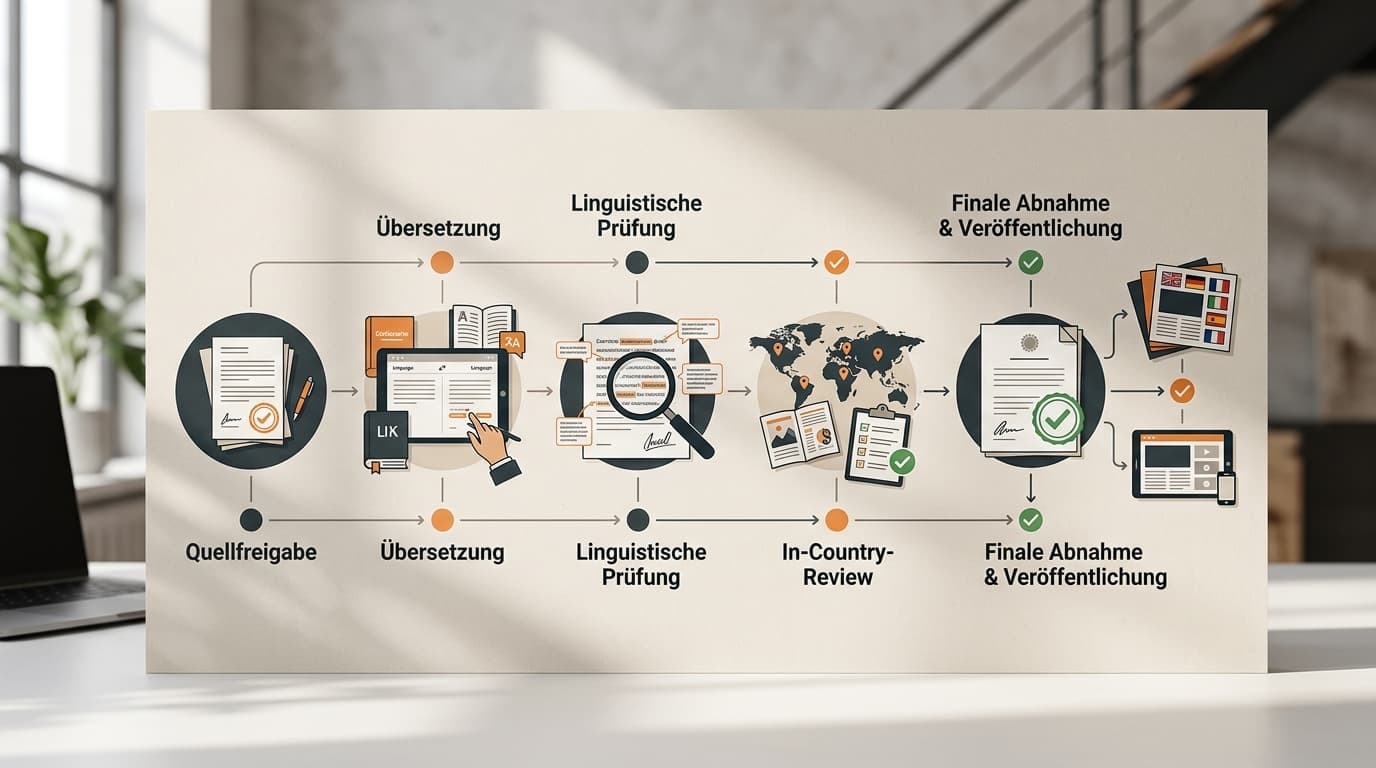
The core workflow: from source approval to publication
Using in-country review effectively as a quality step
Making quality measurable: LQA scores and acceptance criteria
Mastering feedback loops and versioning
Scaling: automated routing with human final sign-off
Frequently asked questions
Sources
Key takeaways
96% of marketers report positive ROI from localization, 65% even three times or more (DeepL study 2023–2024).
99% combine machine translation with human review: approval remains a human-in-the-loop process.
Centralized feedback speeds up approvals by up to 50% and halves the number of revision loops.
82% see industry terminology as the biggest hurdle: glossaries and style guides belong inside the workflow, not alongside it.
Language service providers' revenues fell in 2023 to USD 51.85 billion, below the previous year's level for the first time (CSA Research).
Why the approval workflow decides localization ROI
The economics of localization have shifted. In a DeepL study with Regina Corso Consulting, 96% of the marketing executives surveyed reported a positive ROI on their localization projects, and 65% even achieved at least a threefold return.[1] At the same time, the market for classic language services is shrinking: according to CSA Research, providers' revenues fell from USD 52.01 billion (2022) to USD 51.85 billion (2023). Machine translation is driving down unit costs while content volumes are exploding. The bottleneck is therefore shifting from the translation itself to the process around it: the question of who approves what, and when.[2]
Without a defined approval workflow, the same failure pattern always emerges. Teams lose weeks not to the translation itself, but to the coordination that follows:
Version chaos: reviewers comment on outdated drafts because nobody knows which file is current.
Endless loops: unclear criteria mean the same passage is passed back and forth three times without anyone giving formal sign-off.
Duplicate reviews: two parties review the same thing out of habit, while a high-risk piece of content belongs to no one clearly.
Delayed launches: the content is translated but sits in 'pending clarification' status because of a missing, unnamed approver.
The thesis of this article is therefore: the approval point is the lever for both speed and quality. Machine translation delivers raw speed at almost no cost; whether it becomes market-ready content is decided at the human handoffs. Those who define roles, quality thresholds and in-country review cleanly from the start scale multilingual content without loss of quality and turn the ROI advantage of AI into actually published content.
Define roles and responsibilities cleanly
Structured content approval processes do not begin with tools, but with a role matrix: who may request content, who translates and edits, who reviews it for subject matter, legal and linguistic accuracy, and who ultimately gives the formal sign-off? Enterprise guides recommend recording, for each participant, which tasks they hold and which review or approval authority is attached to them.[3] Precisely this distinction between giving feedback and binding acceptance is the most important lever against endless loops: feedback can be contradictory, an approval cannot.
| Role | Core task | Decision authority |
|---|---|---|
| Requester | Commission content, define briefing and target market | No approval, but may withdraw the assignment |
| Localization manager | Steer the workflow, monitor deadlines, decide escalations | Process ownership, hand-off to the next stage |
| Translator or post-editor | Translate, post-edit machine drafts | Subject-matter approval of the language version |
| Subject-matter expert (SME) | Review terminology, product claims and technical accuracy | Content rejection with justification |
| Legal/Compliance | Review regulatory risks, disclaimers, data protection | Veto in case of compliance violations |
| Final approver | Formal acceptance per language and content type | Binding sign-off for publication |
Three rules keep this matrix workable. First: assign roles by expertise, not by hierarchy, because the best person for the Japanese marketing version is rarely the most senior one. Second: document responsibilities per language and content type, so that a legal review does not randomly apply to every format but is mandatory for contractual documents in every language. Third: each role reviews exactly once, because anyone asked twice will eventually stop answering.
The core workflow: from source approval to publication
The most common and most expensive mistake begins before the first translation: a source piece of content keeps being revised while localization is already underway. Every correction to the original then multiplies across all target languages, because each language version has to be updated individually. Hence the first rule of every enterprise workflow: the source content only goes into localization once it has received final approval. A consistent localization-first approach, as described in the localization playbook, addresses exactly this interface.
Source approval: The original content has been accepted for substance, legal and brand aspects and is frozen.
Translation or post-editing: Machine draft or professional translation, depending on the risk of the content type.
Linguistic review: A professional linguist checks grammar, style and terminology of the language version.
In-country review: Native speakers and subject-matter experts in the target country assess market fit and cultural appropriateness.
Technical QA: Formats, subtitle timing, audio synchronization, layout and links are verified.
Final acceptance: The approver gives the formal sign-off per language.
Publication: Delivery via the planned channels, followed by archiving of the approval record.
Two design decisions determine the turnaround time. First, the choice between linear and parallel acceptance: in ButterCMS, in the linear process each stage runs one after the other, while in the parallel process several parties review simultaneously, which is faster for complex content but requires more coordination.[3] As a rule of thumb, the parallel run suits low-risk content such as social clips, while legally sensitive formats run linearly. Second, every stage needs a defined criterion for hand-off or rejection, such as an LQA threshold or a checklist. Without this criterion, the stage becomes a matter of taste, and matters of taste are the most expensive loops in the process.
Using in-country review correctly as a quality step
In in-country review, a native speaker in the target country reviews the translation – typically an employee at the local site who masters both languages and knows the market.[4] This step is indispensable, because here it is decided whether the content really works in the market. In practice, however, it is also the slowest step: these reviewers are usually not professional linguists but work through the review alongside their actual job, often with limited context and without access to glossaries and style guides. The result is follow-up questions, additional review rounds and delays.
Involve early: bring reviewers in during content creation rather than at the end, and provide them with glossaries and style guides so they are not reviewing against unknown requirements.
Review in context: review in the finished layout, in video and in audio rather than isolated text snippets, because a sentence that looks correct in the editor can break in a subtitle or a spoken script.
Feed feedback back in a structured way: systematically capture reviewers' changes and feed them into translation memories and glossaries, so future projects benefit from these corrections and the same errors are not discussed again.
The last point is the most commonly missed lever. When an in-country reviewer's corrections flow into the language data just once, the reviewer never has to make them again: every subsequent language version starts from the corrected state, which reduces review rounds and turnaround time. The step-by-step setup of such a localization chain, from transcription to mixing the language versions, is easy to follow using the example of a podcast workflow.
Making quality measurable: LQA scores and acceptance criteria
Gut feeling is not an acceptance criterion. Linguistic quality assurance (LQA) replaces it with objective error categories and scorecards, such as those built on the MQM framework (Multidimensional Quality Metrics): a hierarchical catalog of error types across seven core dimensions such as Accuracy, Fluency, Terminology and Style, with assigned severity levels and a scoring formula that calculates a numerical quality value from errors.[5] Errors are therefore counted and weighted, not debated.
| Severity level | Impact on the content | Multiplier (MQM standard) |
|---|---|---|
| Neutral | Acceptable alternative, flagged only for the translator's awareness | 0 |
| Minor | Limited impact on comprehensibility or style | 1 |
| Major | Significantly impairs comprehensibility, reliability or usability | 5 |
| Critical | Makes the content unusable or carries serious risk; triggers an automatic fail in many systems | 25 |
On this basis, acceptance thresholds can be defined per content type: marketing content with high visibility deserves stricter limits and higher weighting for style and audience errors, while internal training materials are measured more against accuracy and terminology. The MQM model provides its own weightings per error type for this purpose and, at high volumes, works with samples of typically 500 to 20,000 words, while a full review is reserved for high-risk content such as legal or medical formats.[5] This keeps the review effort scalable without leaving the approval standard to chance.
Mastering feedback loops and versioning
Scattered feedback is the silent budget eater of localization. Comments in emails, chats and separate documents lead to version confusion, overlooked objections and repeated rework. According to zipBoard, organizations that centralize and structure their review processes achieve up to 50% faster approvals and up to 50% fewer revision loops.[6] The effect comes not from the tool alone, but from the fact that every comment is tied to a version and every decision has an owner.
Version control: every review cycle runs against a unique version, so no one comments on outdated drafts anymore and corrections are applied twice.
Audit trail: who approved what and when is documented without gaps, which forms the basis for evidence in regulated content and internal escalations.
Automated workflows: routing, reminders and status tracking run automatically, reducing manual coordination and shortening the turnaround time of review and approval steps.[7]
Keeping communication costs in view: poor communication costs US companies around USD 12,506 per employee per year, according to the State of Business Communication Report by Grammarly and Harris Poll – an amount that shows up directly in lost review hours.[8]
For enterprise teams this means: feedback is a workflow step with a deadline, a version and an owner, not email traffic on the sidelines. It is precisely this discipline that makes approvals plannable, because an approval whose lead time nobody knows is no approval in the publishing calendar at all.
Scaling: automated routing with human final approval
The target picture for enterprise teams is not a workflow without humans, but a workflow that deploys humans deliberately. Routing rules automatically decide which content is machine-translated and when a human reviews it. Practice clearly shows that human final approval does not go away: 99% of the marketing executives surveyed in the DeepL report have machine translations reviewed by a human.[9] The approval workflow is therefore not the counterpart of automation, but its prerequisite.
Embed terminology: Glossaries and terminology databases belong directly in the workflow, because 82% of respondents named industry-specific terminology as the greatest challenge in translation.[9]
Central workspace: Translation, re-voicing and packaging in over 100 languages come together in one place, so that all approval stages work on the same version instead of across tool boundaries.
Evaluate metrics: Cycle time per stage, number of revision rounds and LQA score are evaluated regularly and translated into adjustments to roles, thresholds and routing rules.
This is precisely where the circle closes back to the tool: An AI-native localization workspace like ContentHub Studio by Dictem keeps source content, language versions, review status and approvals in one place, instead of distributing them across translation tools, subtitle editors and email chains. Those who also know the selection criteria for content localization tools can set up workflow and platform together, rather than thinking of the two separately. The real advantage then comes not from the fastest translation engine, but from an approval workflow that makes every round measurably faster and every language version measurably better.
Frequently asked questions
What is an approval workflow in content localization?
An approval workflow is the defined chain of review and acceptance steps that multilingual content goes through before publication: source approval, translation or post-editing, linguistic review, in-country review, technical QA and final sign-off. Each stage has a clear criterion for forwarding or rejection and a responsible role.
Who should be involved in a localization approval process?
Typical roles include the requester, localization manager, translator or post-editor, subject-matter experts for the content, legal and compliance reviewers for regulated content, and the final approver. The key is separation: reviewers give feedback, approvers give the formal sign-off. Roles should be assigned by expertise and language, not by hierarchy.
Why is in-country review so important and often so slow?
The in-country reviewer is usually an employee in the target market, a native speaker and subject-matter expert at the same time, but not a professional linguist, and reviews alongside their day-to-day work. Without glossaries, style guides and context (layout, image, audio), questions arise, additional review rounds and conflicts with headquarters. Early involvement and in-context review significantly shorten the in-country review.
How do you objectively measure the quality of localized content?
With linguistic quality assurance (LQA): translations are scored against a scheme of objective error categories, often based on the Multidimensional Quality Metrics framework, and aggregated into a numerical quality score. From this, acceptance thresholds are derived per content type, for example stricter criteria for marketing than for internal training materials.
Is localization economically worthwhile for companies at all?
Yes. In the DeepL study 2023-2024, 96% of the marketers surveyed reported a positive ROI from their localization work, and 65% even reported an ROI of at least threefold. Efficient approval processes thus become a competitive factor, because they determine how much of this potential is actually published.
How much automation makes sense in the approval workflow?
Automation should handle routing and coordination: rules decide which content is machine-translated and when a human reviews it. Final sign-off remains with humans, because 99% of the marketing leaders surveyed combine machine translation with human review. Automated approval workflows additionally reduce manual coordination effort and shorten cycle time.
What are the most common mistakes when setting up a localization approval workflow?
The classic mistakes: source content moves into localization before final approval, feedback is scattered across email and chat instead of a platform, reviews run on outdated versions, and there are no documented acceptance criteria. The result is endless loops and missed deadlines. Centralized feedback with version control and an audit trail significantly shortens such revision cycles.
Sources
[1] deepl.com – https://www.deepl.com/en/blog/navigating-localization-challanges-report
[2] tcworld.info – https://www.tcworld.info/e-magazine/translation-and-localization/welcome-to-the-post-localization-era-1314
[3] buttercms.com – https://buttercms.com/blog/establish-content-approval-process/
[4] lionbridge.com – https://www.lionbridge.com/blog/translation-localization/how-in-context-review-language-technology-automates-and-shortens-the-translation-review-process/
[5] themqm.org – https://themqm.org/error-types-2/the-mqm-scoring-models/
[6] zipboard.co – https://zipboard.co/blog/collaboration/content-review-and-approval-best-practices-tools-automation/
[7] blog.box.com – https://blog.box.com/content-review-process
[8] grammarly.com – https://www.grammarly.com/business/learn/state-of-business-communication-research/
[9] deepl.com – https://www.deepl.com/de/blog/navigating-localization-challanges-report
Ready to go global?
Translate, re-voice, and package your content for every language, with Dictem.
Open Dictem Studio